



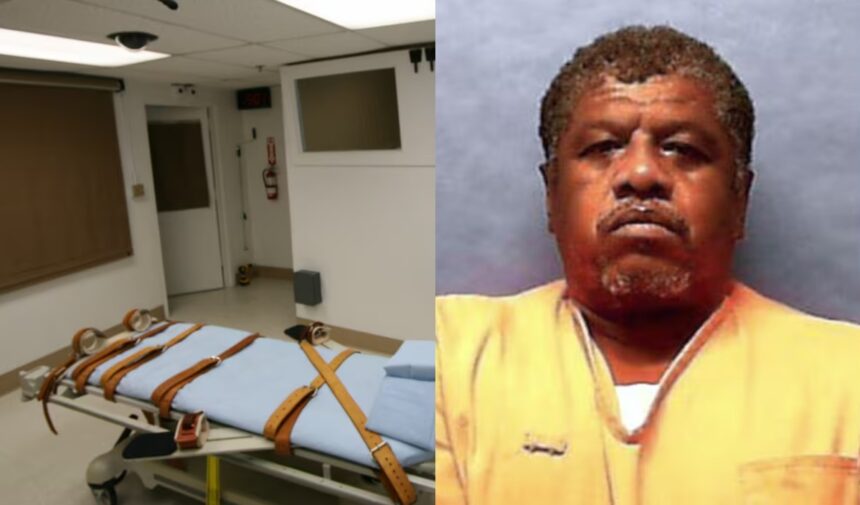
The state of Florida on Thursday gave lethal injection to inmate Curtis Windom for a 1992 triple murder, extending its record number of executions in a single year to eleven and the number across the United States in the past eight months to thirty.
The Florida Department of Corrections executed Windom, 59, at 18:17 local time (22:17 GMT) at the Florida State Prison in Raiford, in the northern part of the state, the agency said.
“Windom’s face was covered by a sheet when the curtain was lifted in the death chamber shortly before the injection began. He said something about being on death row, but it was not intelligible.”
Since the U. S. Supreme Court reinstated the death penalty in 1976, the annual high for executions in Florida had been eight in 2014.
In 2025, the state has already surpassed that figure with eleven executions, more than any other in the country, followed by Texas and South Carolina with four each, in a context of an upturn in this punishment.
This week, as part of the federal government’s intervention in Washington’s city security issues, President Donald Trump even signaled that his administration will seek the death penalty for murders committed in the U.S. capital.
He noted that this is a “very strong preventive measure” in the face of “rampant crime” in the city, which contrasts with local legislation in the District of Columbia, which abolished capital punishment in 1981, although the federal jurisdiction retains that power.
For the Southern Poverty Law Center (SPLC), this is an “aberrant directive,” noting Thursday that the death penalty “has been disproportionately applied against black, Latino and poor communities and has failed to reduce crime.”
The civil rights organization warned that the measure does not seek to “make communities safer,” but is “another distraction from the administration’s actions that make us all less safe and move us closer to authoritarianism.”
The eleventh execution
Windom was sentenced to death for a triple murder he committed in 1992 in the Orlando area of central Florida, armed with a revolver.
According to testimony at trial, the sentenced man first killed Johnnie Lee, a man he accused of owing him $2,000, whom he shot twice in the back from his vehicle and then twice more at point-blank range.
He then went to the apartment of his partner Valerie Davis, mother of Curtisia, one of Windom’s daughters, and killed her in front of a friend of the victim who witnessed the crime.
As he left the home he randomly shot and wounded another man before eventually also killing Davis’ mother, Mary Lubin, who was driving to her daughter’s home and was stopped with her vehicle at a stop sign.
Curtisia Windom had led a public campaign to stop her father’s execution. “We’ve all been traumatized,” she told the Orlando Sentinel, but added that “if we were able to spare him, I don’t see why people on the street who haven’t been through our pain have the right to say he should die.”
In Florida, executions are carried out by lethal injection, with a three-drug protocol: a sedative, a paralytic and a heart-stopping drug.
Its use has been controversial because of the risks of physical suffering during execution, errors in the application of the drugs, and the ethical debate as to whether it really constitutes a ‘humane’ method of capital punishment.
On August 19, Kayle Bates, 67, was executed in Florida for the murder of a woman he had kidnapped, and on September 17, a twelfth inmate, David Joseph Pittman, 63, is scheduled to be executed, which would set a new annual record for capital punishment in the state, according to EFE.
For more information, visit QuéOnnda.com.