





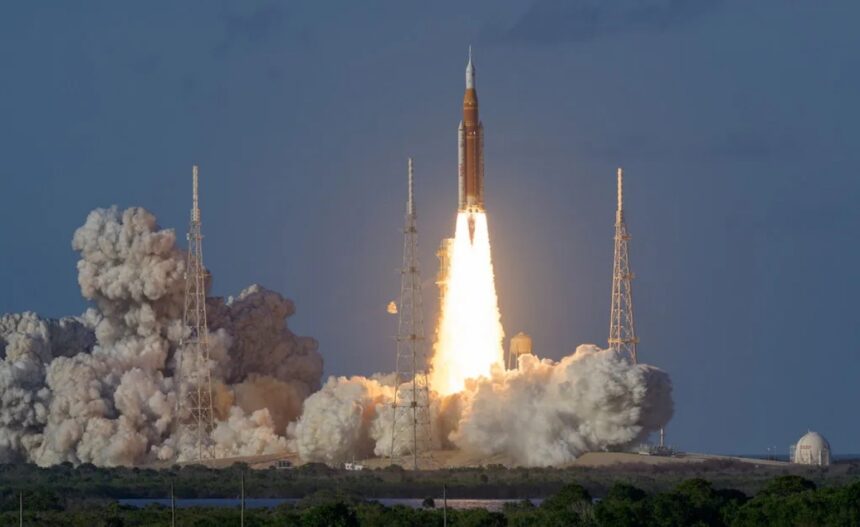
The roar of the Space Launch System (SLS) rocket once again shook the shores of Florida, marking the return of humans to lunar orbit after more than half a century.
The launch of Artemis II was a success and the mission is now in deep space after a “terrifying few minutes” that tested the nerves of steel of NASA and the four crew members aboard the Orion capsule.
Eight minutes of heart-pounding and tension on the platform
Liftoff.
The Artemis II mission launched from @NASAKennedy at 6:35pm ET (2235 UTC), propelling four astronauts on a journey around the Moon.
Artemis II will pave the way for future Moon landings, as well as the next giant leap – astronauts on Mars. pic.twitter.com/ENQA4RTqAc
– NASA (@NASA) April 1, 2026
The takeoff, originally scheduled for 18:24 local time, was slightly delayed by 11 minutes due to two technical failures that almost forced an abort.
First, a communications system failure set off safety alarms; second, a sensor detected that a Launch Abort System (LAS) battery was hotter than normal.
Fortunately, the engineers in Houston gave the green light and, at 18:35, the fire colossus rose into the sky.
The first eight and a half minutes were crucial.
As Carlos García-Galán, director of NASA’s Moon Base, explained, this is the period of maximum structural pressure.
Once that time had passed, success was confirmed: the Orion was in the correct orbit.
“Successful launch,” echoed the control center, sparking applause from thousands of spectators.
Rescue mission… to the toilet!
The Orion spacecraft successfully separated from the upper stage of the rocket, and the “proximity operations” test is underway. The Artemis II astronauts are manually piloting Orion similarly to how they would if they were docking with another spacecraft. pic.twitter.com/RWW4RSyaoq
– NASA (@NASA) April 2, 2026
But life in space is not just about quantum physics and orbits; it also has very earthly challenges.
Once in space, the crew detected a blinking malfunction light in the ship’s toilet.
This device is one of the great technological innovations, since in the Apollo missions of the 1960s and 1970s, astronauts had to use bags for their waste.
After hours of uncertainty and coordinated work with Houston, NASA confirmed that the malfunction was resolved and the restroom is operating normally.
Total relief for Reid Wiseman, Christina Koch, Victor Glover and Jeremy Hansen!
Destiny: The hidden side of the Moon
ARTEMIS II🚨: In the mission, the 4 astronauts will travel 400,000 km from Earth, which would be the farthest any human has ever gone in all of humanity. pic.twitter.com/emEczRx0j5
– All day Astronomy (@forallcurious) April 1, 2026
Currently, astronauts orbit the Earth to verify that all systems are at 100% before making the final jump to the natural satellite.
If all goes according to plan, next Monday, April 6, they will reach the far side of the Moon, arriving at a distance of more than 400,000 kilometers from our planet, the farthest point in deep space ever reached by a human being.
Artemis II is the prelude to what is to come in 2028: the return of man (and the arrival of the first woman) to the lunar surface to establish a permanent base.
For now, the journey continues and the whole world watches in amazement.
Can you imagine being 400,000 kilometers away from home and having your toilet break down?
Filed under: Artemis II launch