




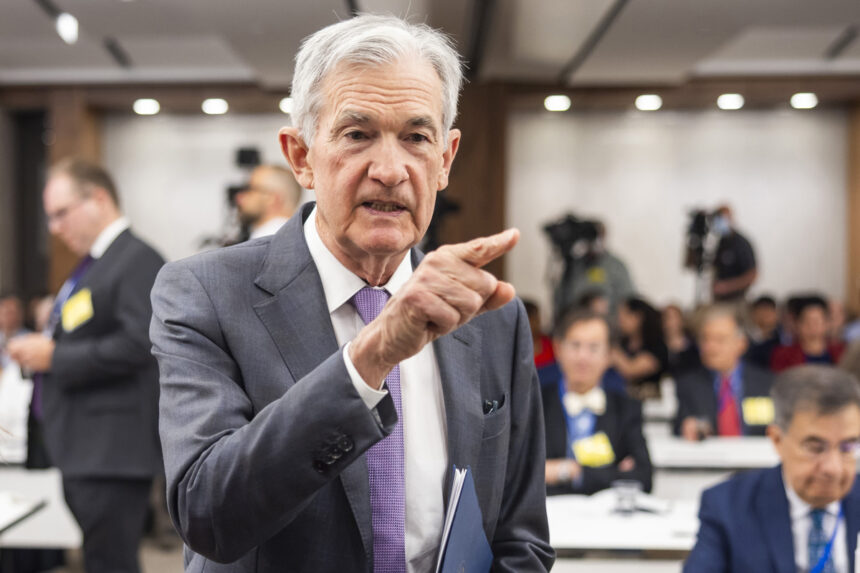
The U.S. Federal Reserve on Wednesday announced its first interest rate cut in nine months, cutting the benchmark by a quarter point to a range between 4 and 4.25%, and pointed to further reductions between now and the end of the year at a time marked by the economic slowdown and growing downside risks to employment.
A majority of members of the agency’s Federal Open Market Committee (FOMC) believe that by the end of the year an appropriate level for the price of money would be in a range between 3.5% and 3.75%, 50 basis points below the current level, the Fed’s latest summary of projections shows.
Fed cuts interest rates by a quarter point
The Fed cuts interest rates 25PBS and expects 2 more cuts this year to bring the rate to 3.6% by the end of 2025.
Here are the new updated projections: pic.twitter.com/DC2I3L9k79– Javier DV (@Javieerdelvalle) September 17, 2025
This shows a majority consensus towards approving two more cuts like today’s at the FOMC meetings scheduled for October and December.
However, the president of the entity, Jerome Powell, reminded a press conference that “as is often the case, these individual forecasts are subject to uncertainty” and that the monetary policy of the agency never follows “a pre-established course”.
In the statement to explain its first rate cut since Donald Trump returned to the White House, the Fed stressed that economic uncertainty “remains elevated” and that downside risks to employment “have increased.”
Los indicadores recientes sugieren que el crecimiento de la actividad económica se moderó en el primer semestre del año. La creación de empleo se ha desacelerado y la tasa de desempleo ha aumentado ligeramente, pero se mantiene baja
Reserva Federal
Inflation forecast intact
In that sense, the Fed kept intact its inflation projection for this year, which it places at 3%, above its target of 2% at a time when prices in the US have begun to absorb the effects of the tariffs of the trade war waged by Trump.
“The increase in tariffs has begun to push up prices for some categories of goods, but its overall effects on economic activity and inflation remain to be seen,” the Fed chairman noted.
Powell assured that the agency is closely assessing the possibility that, beyond a one-off increase, the trade war will generate “more persistent changes” in prices.
In turn, the Fed now sees gross domestic product growing by 1.6% in 2025, up from the 1.4% projected in the previous report.
In any case, this is a level that is well below the 2.5% recorded in 2024, as Powell recalled, stressing that the fall in consumption is a key factor in the current slowdown in the world’s leading economy.
Powell was also keen to highlight the key role that the drop in immigration due to new U.S. border policies has played in the slowdown in hiring.
“What’s happening in the labor market has more to do with immigration than it does with tariffs,” Powell said.
The Fed president pointed out that there is virtually zero growth in the supply of workers while demand has fallen “quite sharply” in what he called a “curious balance”.
Fed cuts interest rates
The Fed chairman also defended the decision not to opt for a half-point cut, as proposed by Stephen Miran, a new member of the Board of Governors proposed by Trump, who since coming to power has pressured Powell to accelerate rate cuts.
“We tend to make big rate cuts at times when you deem it necessary to move quickly from one point in (monetary) policy to another.
“That’s not at all what I consider now. I think we’ve done the right thing so far this year. We were right to wait and see how tariffs, inflation and the labor market evolved,” Powell said.
Asked about Miran’s arrival and the Trump Administration’s onslaught to undermine the institution’s independence, Powell merely noted that the FOMC “remains united in pursuing our objectives.”
“We are firmly committed to maintaining our independence and beyond that, I really have nothing more to comment on,” he concluded.
With information from EFE