





A U.S. federal appeals court ruled on Friday, August 29, that President Donald Trump did not have legal authority to impose a series of tariffs on dozens of countries under the 1977 International Emergency Economic Powers Act (IEEPA). The court concluded that the use of this law was an excess of presidential power, as it was designed solely for national emergencies and not as a trade policy tool.
Trump’s tariff policy will remain in place until mid-October because the ruling is intended to allow time for a possible appeal by the Trump administration to the Supreme Court, according to the ruling issued by the Federal Circuit Court of Appeals.
Trump reacts to ruling
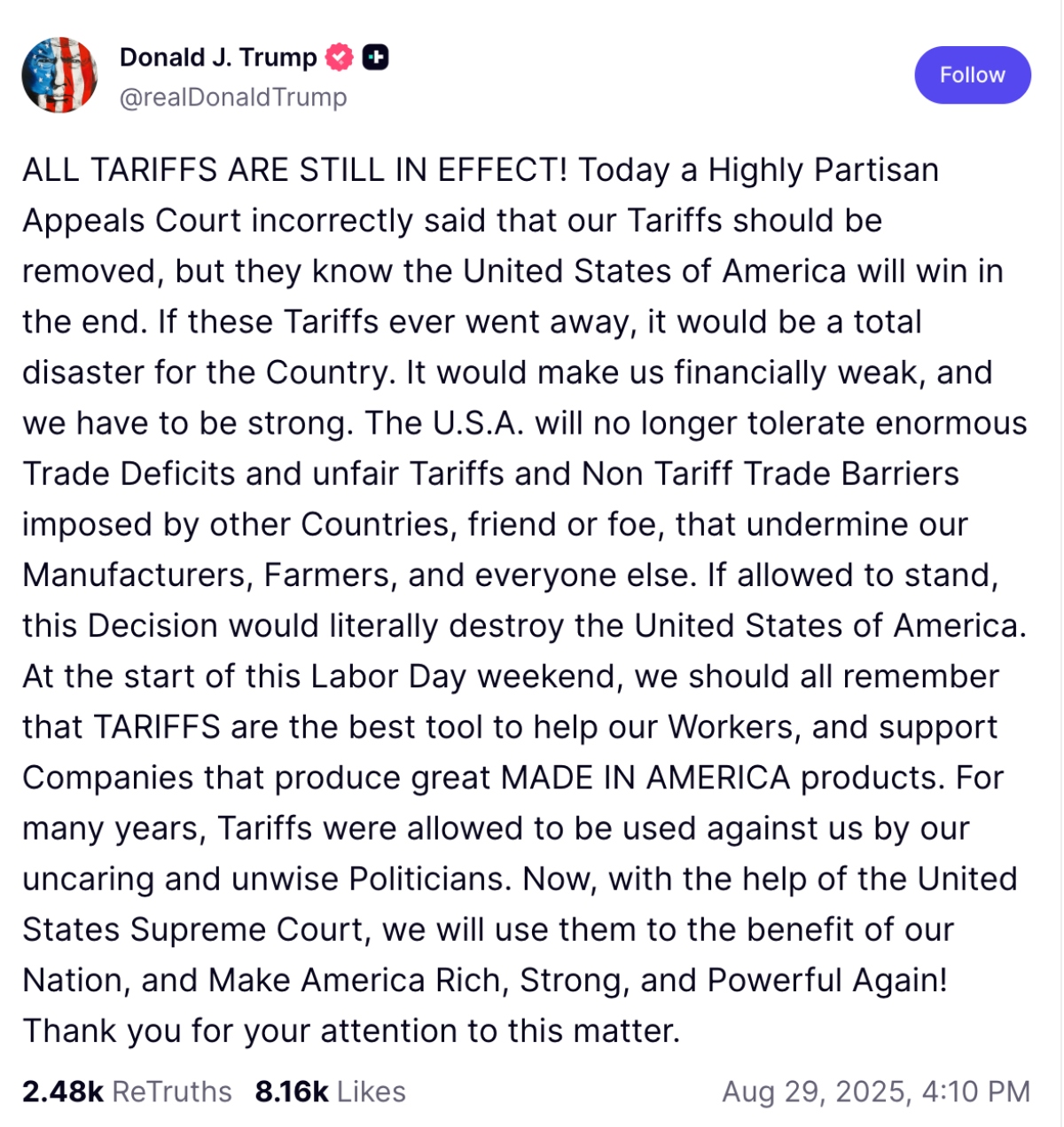
President Donald Trump has already anticipated that he will appeal the ruling in a message on his social network Truth Social.
“ALL TARIFFS ARE STILL IN FORCE!” he warned at the beginning of his message in capital letters.
“Today, a highly partisan appellate court incorrectly said our tariffs should be eliminated, but they know the United States of America will win in the end,” he added in his message.
“If these tariffs were to disappear, it would be a total disaster for the country,” the president sentenced. “It would weaken us financially, and we have to be strong.”
The president also said that “America will no longer tolerate huge trade deficits or unfair tariffs, or non-tariff trade barriers imposed by other countries, friend or foe, that hurt our manufacturers, farmers and everyone else.”
Trump went further to say that “if this decision is allowed to stand, it would literally destroy the United States of America.”
He said, apropos of Labor Day weekend, that “we must all remember that tariffs are the best tool to help our workers and support companies that produce excellent MADE IN AMERICA products.”
In his opinion, “for many years, our callous and reckless politicians allowed tariffs to be used against us. Now, with the help of the U.S. Supreme Court, we will use them to our nation’s advantage and make America rich, strong and powerful again.”
Why tariffs are still in force
Despite the decision, the court clarified that the tariffs will remain in effect temporarily while the possibility of an appeal to the Supreme Court of Justice is resolved.
This move seeks to avoid a loophole and allow time for the nation’s highest court to determine whether Trump actually abused his authority by extending his trade policy under the cover of a law intended for another purpose.
In practice, this means that tariffs will continue to impact importers, exporters and consumers in the United States.
Direct impact for U.S. Hispanics.
The Latino community in the United States is also directly affected by the legality of Trump’s tariffs.
Many small entrepreneurs, restaurant owners, retail stores or import businesses rely on products brought in from Mexico, Central America or China.
Tariffs raise the cost of these imports and, consequently, end-consumer prices.
For example:
Tariffs on steel and aluminum made construction materials more expensive, affecting Latino contractors and workers in the construction sector.
Tariffs on imported consumer products made inputs for Latino restaurants and stores more expensive.
In the case of migrants who send remittances, the higher cost of living limits their ability to save and send money to their families abroad.
Difference with other tariffs
The ruling does not affect tariffs on vehicles, steel and other goods that Trump imposed under a different law, Section 232 of the Trade Expansion Act of 1962, which allows restrictions for national security reasons.
These measures, much criticized by the automotive industry and the construction sector, remain intact and continue to make commodities more expensive in the U.S. market.
Legality of Trump’s tariffs
The aggressive use of tariffs has been one of the hallmarks of Donald Trump’s economic policy, both in his first term (2017-2021) and in his current term.
His argument has been that these measures are necessary to protect U.S. jobs and reduce dependence on countries like China in strategic sectors.
However, critics, trade experts and now the judiciary warn that Trump has improperly used legal tools designed for emergencies, not protracted trade negotiations.
The Ninth Circuit Court of Appeals ruling reinforces that view by declaring that the former president “exceeded” his authority.
What’s next
The case could go to the Supreme Court, which will have the final say on the constitutionality of the use of IEEPA to impose tariffs.
In the meantime, U.S. importers and consumers will continue to pay the costs of these policies.
For U.S. Hispanics, the message is clear: these tariffs are not only a foreign policy issue, but they directly affect the price of the basic food basket, work materials and families’ pocketbooks.
The federal court ruling opens a profound debate on the limits of presidential power in trade matters and on the future of the tariffs that have marked Trump’s economic policy.
Although the court questions their legality, for now, the tariffs remain in place, putting on hold the economic relief that many businesses and families are hoping for.
Lo que ocurra en los próximos meses puede determinar si los precios bajan o continúan aumentando en sectores clave como la alimentación, la construcción y los bienes de consumo
QuéOnnda.com