





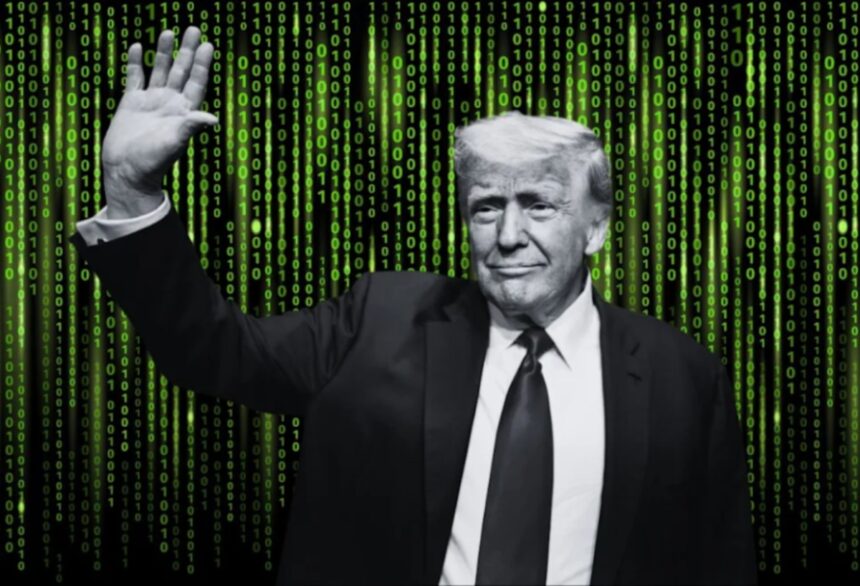
President Donald Trump’s administration is dramatically expanding the use of artificial intelligence (AI) in immigration enforcement.
The new technological tools not only make it possible to track migrants, but also help determine who is subject to deportation, marking a significant shift in border control strategy. Here’s how Trump is using AI to control migration.
ImmigrationOS: the new control platform
To meet one of Trump’s top policy priorities, the Department of Homeland Security (DHS) has launched ImmigrationOS, a system that centralizes key processes into a single interface.
From there, Immigration and Customs Enforcement (ICE) agents can approve raids, record arrests, generate legal documents, and even arrange deportation flights or transfers to detention centers.
According to senior DHS officials, the goal is to speed up processes that previously relied on slower manual reviews.
The technology also incorporates information from various agencies, including the Treasury and the Internal Revenue Service (IRS), as well as census and financial transaction data mandated by the Bank Secrecy Act.
Artificial intelligence in immigration practice
Acting ICE Director Todd Lyons went so far as to compare the system to the efficiency of Amazon’s delivery routes, albeit applied to immigration raids.
“Like Prime, but with human beings,” he said during an exhibition in Phoenix.
Unlike previous tools that only provided facial recognition or identity checks, ImmigrationOS is considered a prescriptive system: it guides agents on what steps to take rather than simply pointing out possible irregularities.
This, according to experts, represents a profound shift in the way immigration laws are applied.
Criticisms and risks of automation
Despite the advances, immigrant advocacy organizations warn that the increasing reliance on algorithms poses risks of bias and reduces human oversight.
Steven Hubbard, a data scientist at the American Immigration Council, warned that these automated decisions can have serious consequences for real people, from detentions to expedited deportations.
A former DHS official explained that ImmigrationOS decentralizes decision-making power, as agents in the field can now directly access the system.
In his words, “the idea is to bring AI to the operators and let them use it as they see fit, rather than managing it from headquarters.”
However, critics warn that this flexibility may translate into less accountability, as algorithms tend to be non-transparent and difficult to audit.
Palantir and the role of contractors
The system was developed with the collaboration of Palantir, a regular U.S. Government contractor also linked to the Department of Defense.
Earlier this year, ICE awarded the company a nearly $30 million contract to start up ImmigrationOS.
For some experts, this technological dependence raises additional concerns.
“Much of the IT infrastructure now requires Palantir’s tools to function,” noted a former DHS official, warning that this ties the agency to a single vendor and limits operational independence.
From national security to everyday life
Artificial intelligence was already present in DHS tasks during the previous administration, such as fraud detection, identity verification or internal chatbots.
However, under Trump its reach has been extended to day-to-day operations, including audits of I-9 forms, which verify workers’ employment eligibility.
A former senior official noted that AI now allows this work to be done more quickly and efficiently, identifying discrepancies in passports, visas and green cards.
But he warned that, without proper oversight, efficiency can end up crowding out human judgment.
The debate on the use of AI
Former ICE directors and migration specialists agree that the question is not whether artificial intelligence is useful, but how it is implemented.
John Sandweg, former acting head of ICE, acknowledged that these tools can be positive in identifying threats and terrorism cases. However, he questioned the need to use them in routine raids.
“It doesn’t take AI to go to Home Depot and arrest people,” he ironized.
Consequently, the debate over the role of AI in Trump’s immigration policy remains open.
As the White House seeks to maximize arrests and deportations through cutting-edge technology, experts and activists insist that oversight and transparency must be a priority to protect civil rights in an increasingly automated system.
This article was originally published in Nueva News.
Filed under: How does Trump use AI to control migration?