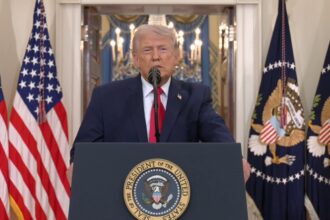





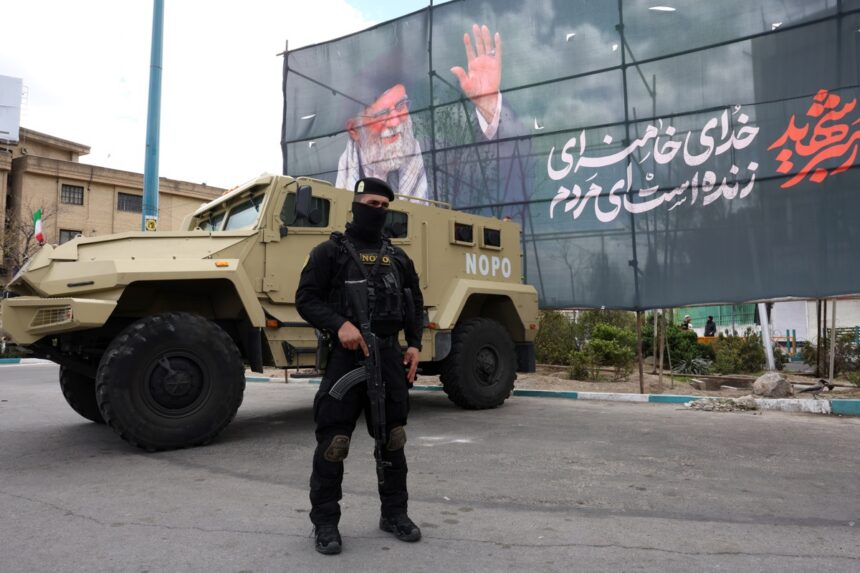
US President Donald Trump assures that Iran has asked for a ceasefire, but Tehran denies it, in a dance of declarations that has become constant in the 33 days since the war began, although officially and on paper the talks are non-existent.
While Trump makes any truce requested by Iran conditional on the full reopening of the Strait of Hormuz and threatens to return the country to the “Stone Age,” missiles continue to crisscross the region, leaving dozens dead and buildings – civilian and historic – destroyed.
Iran calls for truce, but they deny it
Trump’s version: “The new president of the Iranian regime, much less radicalized and much smarter than his predecessors, has just called for a ceasefire with the United States of America! We will consider it when the Strait of Hormuz is open, free and clear,” he said on Truth Social, without specifying which Iranian leader he is referring to.
The denial: The Iranian embassy in Spain and the Foreign Ministry spokesman, Esmaeil Baqaei, “officially” denied any request for a truce. For his part, the vice-president of the Parliament, Ali Nikzad, stressed that the new supreme leader, Mojtaba Khamenei, is the only one with the prerogatives to authorize negotiations and that, so far, he has not done so.
Pezeshkian conditions: “We have the will to put an end to this war as long as the necessary guarantees are put in place to prevent a repetition of any aggression,” the Iranian president told European Council President António Costa in a call.
Lebanon and Iran continue to count the dead
In Lebanon:
- Israeli attacks on the outskirts of Beirut and south of the capital today killed 9 people and wounded 29.
- In total, 1,318 people have been killed and 3,935 wounded by the Israeli air and ground offensive in Lebanon.
- In addition, Israel claims to have killed the commander of Hezbollah’s Southern Front, identified by them as Hajj Yousef Ismail Hashem.
In Iran:
- A bombing near the Hussainiya clinic has killed Alireza Sohbatlou, an Iranian Red Crescent worker. He is the third employee of the humanitarian organization to be killed in a month of conflict.
- The Israeli Army claims to have killed Iranian engineer Mahdi Wafaei, who, according to Israel’s version, was behind the establishment of tunnels to store weapons by Hezbollah and the now defunct Bashar al-Assad regime in Syria.
- In addition, Israel and the US have bombed Tehran’s St. Nicholas Orthodox Cathedral and an adjacent Russian nursing home and the former US embassy in Tehran -reconverted into an anti-Washington museum.
But it also affects other countries
In Israel: An 11-year-old girl has been injured in Iranian shelling in the north of the country. In addition, Houthi rebels in Yemen have again launched a ballistic missile attack, the third in the ongoing war.
In UAE: Falling shrapnel from a drone intercepted in Fujairah killed a Bangladeshi national on a farm.
In Qatar: An Iranian missile hit the oil tanker ‘Aqua 1’, chartered by the state-owned QatarEnergy, in territorial waters in the north of the country. It is the first reported direct attack against a Qatari vessel in this context.
The challenge of Hormuz
The UK will host a meeting later this week – no exact day – with international leaders to “assess all diplomatic and political road measures” to ensure the safety of ships and resume the transport of commodities.
Emirati Minister of Industry and Technology Sultan al-Jaber called for joint global action to open the Strait of Hormuz and protect the free flow of energy in the face of Iran’s “global economic extortion”.
Shipping between Russia and Iran through the Caspian Sea will increase considerably due to the blockade of the Strait of Hormuz, according to Russian Deputy Transport Minister Dmitry Zverev.
And, after days of asking NATO for help with a mission in the strait, today Trump, in an interview with The Telegraph, said he contemplates withdrawing from the Alliance: “I was never thrilled with NATO; I always knew it was a paper tiger.”
UN Trade and Development (UNCTAD) anticipates that the war will slow global economic growth to 2.6% in 2026.
It also predicts an even greater slowdown in merchandise trade growth, from 4.7% in 2025 to between 1.5% and 2.5% in 2026.
Filed under: Iran asks for truce
With information from EFE