





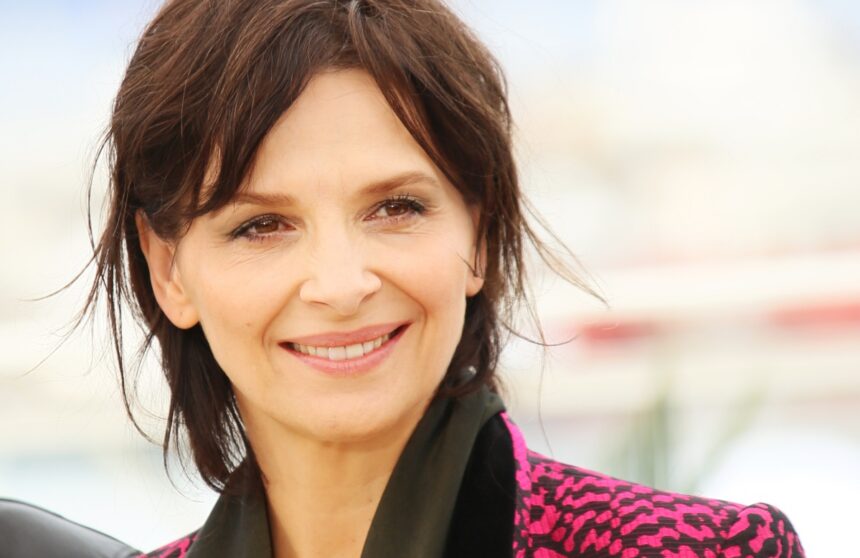
Alzheimer’s or any type of dementia is a disease that not only affects the patient, but also everyone around him and it is something that must be made visible. That is the message of the film ‘Queen At Sea’ and its entire team, led by Juliette Binoche, who presented the film in competition at the Berlinale on Tuesday.
Binoche plays Amanda, who searches for the best way to help her mother, who suffers from advanced dementia and lives in a typical London house, uncomfortable and full of stairs, with her second husband, both in their eighties.
For the French actress, her character tries to “ensure everyone’s safety in an extremely difficult situation” that of treating her mother with Alzheimer’s disease.
In this regard, Britain’s Anna Calder-Marshall, who brilliantly plays the sick mother, Leslie, stressed the importance of a film like this being presented at a festival like the Berlinale. “It’s something that needs to be shared, it needs to be made known and made aware” of the problem it poses for everyone.
It was precisely from this idea that the director, Lance Hammer, who has experienced a problem like the one depicted in the film, came up with the idea. “I wanted to show the suffering involved,” explained the American, who has used different stories he knew or was told in the film.
He even rewrote the script to talk to professionals who deal with these patients, not only from a purely medical point of view, but also from the point of view of social assistance. “The script was constructed as if it were a workshop,” he said.
The story takes place mainly in the house where the elderly couple lives and the situation explodes when her daughter catches them having sex, something she thinks is inappropriate because her mother is not able to give her consent.
The intervention of the police, the social services, the differing opinions of the husband and daughter, all contribute to highlighting the hardship of living with people suffering from some form of dementia.
As a contrast, Sara, who is the third generation of the family is living her first love. That is what attracted actress Florence Hunt, who has become very popular for her role as Hyacinth in the series ‘The Bridgertons’, to this role.
“What I liked most about the script is the proximity of the first love of Sara’s life and the last love of her grandmother,” said Hunt, excited to work with Juliette Binoche and Calder-Marshall, of whom she noted their “ability to commit to a role.”
“You have entered so deeply into your characters that it inspired me to try to do the same,” the actress remarked, looking at her castmates.
Three women face a man, Martin, Leslie’s husband, played by British actor Tom Courtenay, a character as fragile in the film as his wife, although he does not want to admit it.
“It’s very hard for Juliette’s character, because she knows the extent to which Martin loves his wife but is no longer in a position to take care of her, but he is convinced that he can do it because he loves her,” the actor explained.
While Juliette Binoche pointed out that one of the central points of the film is where the limits are, at what point you have to make a decision even if it is hard.
“It’s about reacting responsibly, when you make the decision, who is the best person to make the decision,” the director added.
A film with a strange title that is also born in a curious way.
“At Sea in British English, means to be in danger, to be lost on a cognitive level and I had an image in my kitchen of a queen on a ship leaving for war.” That’s where this ‘Queen At Sea’ came from.
The film, reported Agencia EFE, features delicate cinematography by Brazilian Adolpho Veloso – nominated this year for an Oscar for his work in ‘Train Dreams’ – and shows “the extremely human”, in Binoche’s words.
Find out more at ‘QueOnnda.com’.