



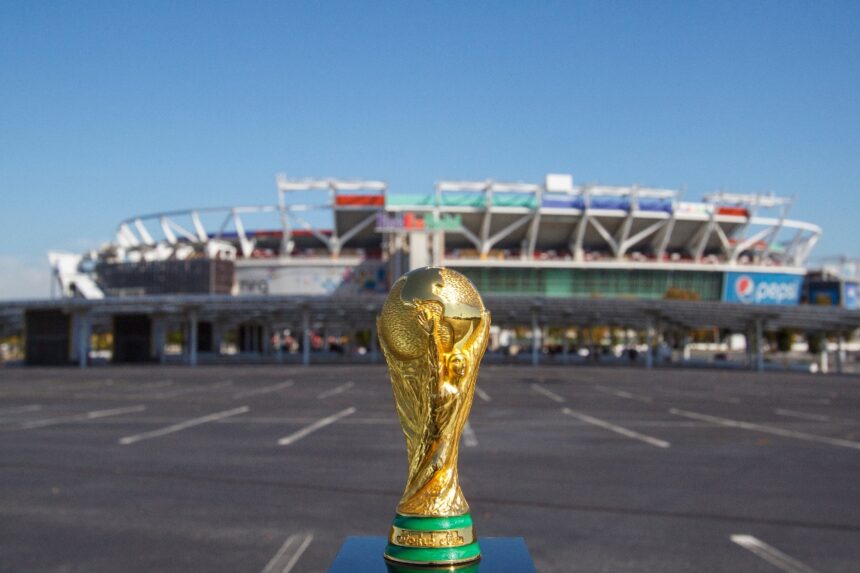
The 2026 World Cup, to be played in the United States, Mexico and Canada, is fast approaching and there are still tickets to be decided through the intercontinental playoff. However, in the midst of this decisive stage, an administrative scandal has arisen that could leave a national team out of the competition for a reason unrelated to the field of play.
Six teams – Bolivia, New Caledonia, Democratic Republic of Congo, Iraq, Jamaica and Suriname – are scheduled to compete in the intercontinental playoffs, from which only two teams will qualify for the 2026 World Cup. These playoffs are scheduled to take place between March 23 and 31, 2026, key dates in FIFA‘s international calendar.
At the center of the controversy

The Suriname national team, the Concacaf representative along with Jamaica, faces a serious risk of disqualification for the 2026 World Cup.
This is due to a legal dispute directly involving their national federation.
A court of law ordered the freezing and review of the bank accounts of the Suriname Football Federation (SVB).
This follows a lawsuit filed by the Oldenstam and Kurban groups.
They expressed their disagreement with the federation’s internal election process.
This judicial decision has caused operational, economic and logistical limitations, directly affecting soccer in the country.
The crisis reached such a level that it led to the resignation of Stanley Menzo as head coach of the national team, leaving the team in a situation of instability just a few months before the 2026 World Cup playoff.
The problem with FIFA’s statutes

The most sensitive point of the case is that FIFA’s statutes expressly prohibit national federations from resorting to ordinary courts to resolve internal disputes.
Instead, such disputes should be settled through the sporting mechanisms recognized by world soccer’s governing body.
If FIFA determines that the Suriname Federation has violated its statutes, the sanction could include the suspension of the national team from all official competitions.
This would automatically leave it out of the playoffs for the 2026 World Cup.
An administrative scandal has emerged
QuéOnnda.com
Impact on Concacaf and the 2026 World Cup

For the Hispanic community in the United States, this case is particularly relevant.
CONCACAF has a limited number of spots and any sanction could alter the playoff format or indirectly benefit another team.
For now, there is no definitive resolution, but the case keeps FIFA, CONCACAF and fans on alert at a critical moment on the road to the biggest World Cup in history.
The 2026 World Cup Scandal shows that, beyond sporting performance, administrative and legal problems can cost a national team its World Cup dream.
Suriname is still awaiting a decision that could mark its soccer future.
For more information, visit QuéOnnda.com.