



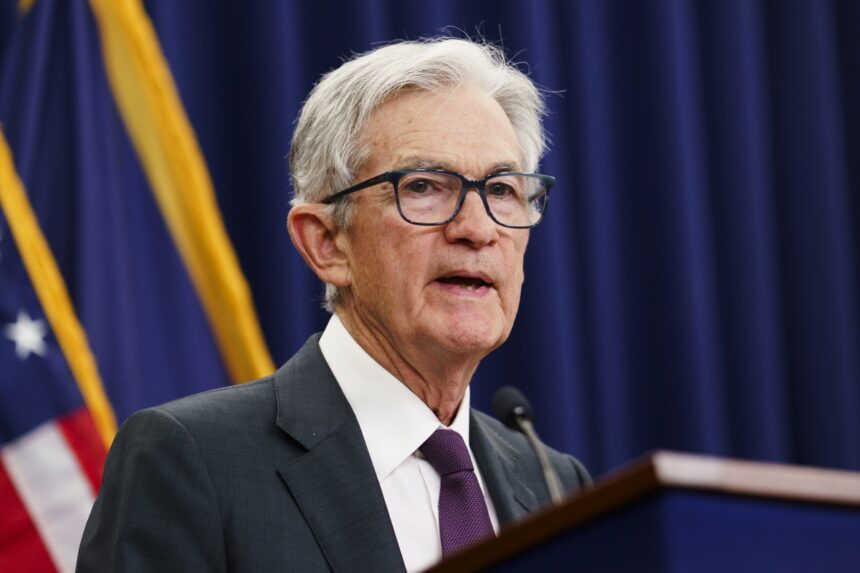
The president of the United States Federal Reserve (Fed), Jerome Powell, warned on Friday, August 22, that the “balance of risks” for the US economy is changing and that the institution could soon be forced to cut interest rates. The message, delivered during his keynote speech at the annual central bankers’ symposium in Jackson Hole (Wyoming), was interpreted by the markets as a sign of a shift in the country’s monetary policy.
Powell explained that the agency he heads has a dual mandate: to keep inflation under control and ensure maximum employment. However, both goals are in tension. “Risks to inflation are skewed to the upside and risks to employment are skewed to the downside, a complex situation when our objectives are so in conflict,” he said. Although current interest rates are “closer to neutral than they were a year ago,” Powell made it clear that the new economic backdrop may warrant “an adjustment in our policy stance.”
Labor market under pressure
One of the Fed’s biggest concerns is employment trends.
According to Powell, the labor market has shown a “curious stability” derived from the fall in both the supply and demand for workers.
However, he stressed that downside risks are increasing, raising fears of a possible labor market slowdown in the coming months.
Tariffs and migration, impact factors
The Fed Chairman also directly addressed the effect of the economic policies of the current U.S. administration led by Donald Trump.
He noted that the substantial increase in tariffs with trading partners is changing the global trading system.
Although Powell acknowledged that the impact on consumer prices could be “relatively short-lived,” he also admitted that “the effects of tariffs on prices are already clearly visible.”
Another factor he highlighted was the restrictive immigration policy of the current administration.
According to Powell, the measures that have limited the inflow of immigrants are causing an “abrupt slowdown in long-term labor force growth.”
This is especially relevant in a country where the immigrant population plays an essential role in sectors such as construction, health care, agriculture and services.
For millions of Hispanics living in the United States, these policies affect not only job opportunities, but also the economic stability of their communities.
Tax and financial implications
Powell also referenced the recent tax and budget reform bill pushed by Trump and passed by Congress in July.
According to the Fed chairman, changes in tax, spending and regulatory policies could have significant implications for the country’s economic growth and productivity.
Analysts have warned that tax cuts, combined with high government spending, could exacerbate the U.S. budget deficit, generating greater uncertainty among investors.
Market reaction to Powell’s announcement and interest rate announcement
Powell’s speech on interest rates had an immediate impact on financial markets.
In the first hour of trading following his remarks, the main Wall Street indexes registered rallies of close to 1.5%.
The Dow Jones Industrials, the Nasdaq and the S&P 500 responded to the optimism of investors who see a possible rate cut as a relief for investment and consumption.
The Fed chairman’s remarks also come amid rising political tensions.
President Donald Trump has on multiple occasions criticized Powell and suggested he should step down from his post.
However, the Fed maintains its institutional independence and Powell reiterated that the agency’s decisions will continue to be based on economic data and not on political pressures.
Ultimately, Powell’s warning on interest rates marks a key moment for the U.S. economy.
The future of interest rates will depend on the evolution of the labor market, the impact of tariffs, immigration policies and the government’s fiscal measures.
For working families, including Hispanic communities, these decisions will have direct consequences on the cost of credit, mortgages, investments and access to stable employment in the coming months.
Los riesgos para la inflación están sesgados al alza y los riesgos para el empleo, a la baja, una situación compleja cuando nuestros objetivos están tan en conflicto
Jerome Powell, jefe de la Fed