





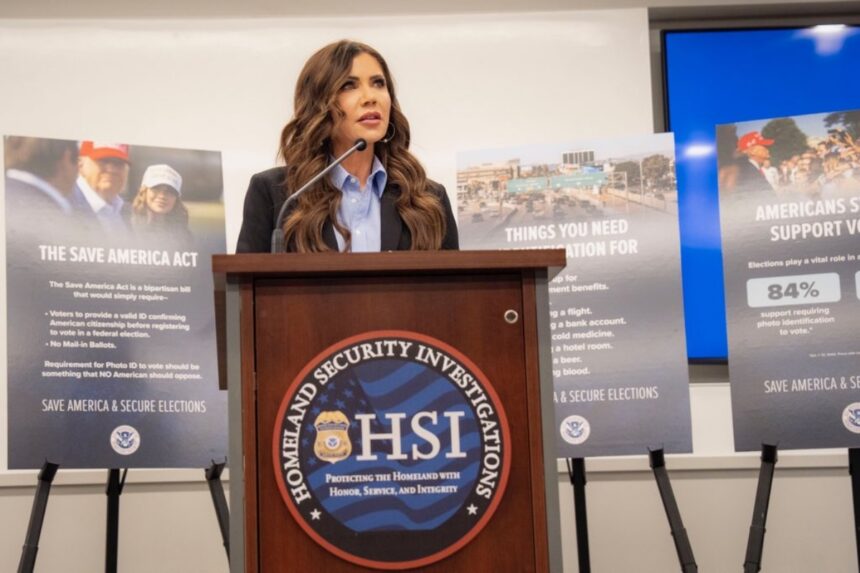
President Donald Trump’s administration on Friday defended the passage of a sweeping bill that would require people who can vote to present proof of citizenship and photo ID to vote in federal elections, which faces opposition in the Senate.
Homeland Security Secretary Kristi Noem defended Friday from Phoenix, Arizona, the bill, dubbed the SAVE America Voter Eligibility Protection Act, which would require states to require voters to provide proof of citizenship when registering to vote, primarily through a valid U.S. passport or birth certificate.
White House backs bill that would require proof of citizenship to vote
Secure elections are vital to maintaining our republic.
Today I joined officials and elected representatives in Arizona to make this abundantly clear: securing our elections is not painful or inconvenient, it is the bare minimum assurance we give to our citizens that their… pic.twitter.com/FGGlyempUY
– Secretary Kristi Noem (@Sec_Noem) February 13, 2026
The initiative also requires voters to present a valid photo ID before they can cast their ballot, a requirement that is already in place in most states.
The plan, approved this week by a majority of the House of Representatives, also imposes new rules for vote-by-mail ballots, requiring voters to present a copy of a valid ID when mailing in their ballot.
At a press conference, Noem insisted that passage of the bill would prevent undocumented immigrants from voting, a Republican rhetoric that led several states in the 2024 election to try to impose bans on voter rolls.
But research shows that voter fraud by non-citizens is extremely rare, a Brennan Center For Justice study found that only 0.0001% of the 23.5 million votes cast in 42 jurisdictions surveyed in the 2016 election were allegedly non-citizen votes. Only two of those jurisdictions reported possible cases.
For its part, the Heritage Foundation, a conservative analysis group, identified just 23 instances of non-citizen voting between 2003 and 2022 in a related study.
Noem also insisted on the need to establish photo identification for people voting in person, but currently 37 of the 50 states require it and the remaining states have other methods of identity verification.
The Trump-backed bill will be voted on in the Senate, where it faces a difficult path because it needs a Democratic vote and even some conservative lawmakers have said they will vote against it.
The U.S. Constitution gives the states control over voting and voting guidelines.
Republicans in Arizona failed in 2024 to impose voting restrictions.
With information from EFE