




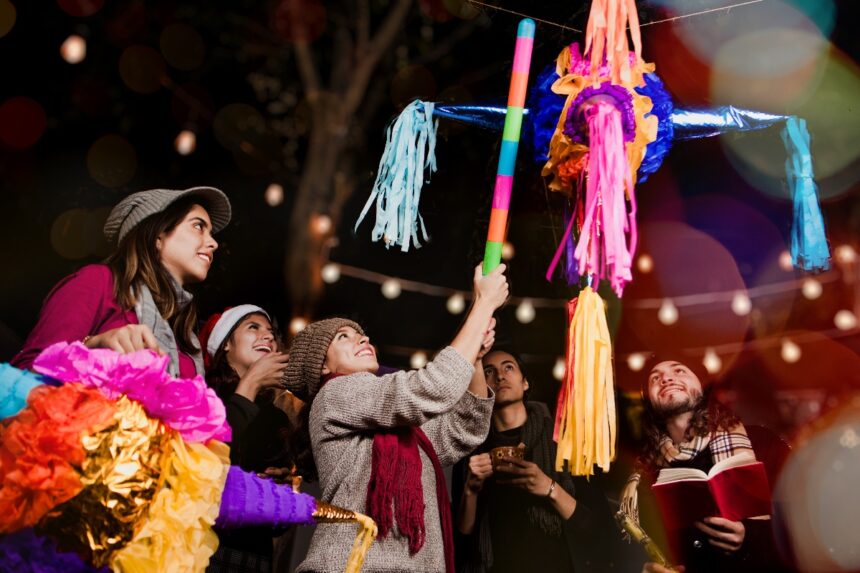
During the Posadas, one of the most awaited moments -especially by children- is breaking the seven-cornered piñata. Although today it is usually seen as a simple game full of candy and fun, its origin and symbolism have a much deeper meaning, linked to history, religion and Mexican cultural identity.
For many Hispanic families in the United States, understanding this background is a way to keep the tradition alive beyond the holiday.
Historical origin of the piñata
Did you know that the traditional posadas were held for the first time in the atrium of the convent and temple of San Agustín de Acolman? In that place, piñatas were broken for the first time, which represented through their 7 peaks the 7 deadly sins, as well as the… pic.twitter.com/Wm2seqkeVL
– Tlatoani_Cuauhtemoc (@Cuauhtemoc_1521) December 17, 2024
The piñata arrived in Mexico in the 16th century, during the Spanish evangelization.
Although there are similar antecedents in China and Europe, it was in Mexico where it acquired its religious and community significance, particularly within the Posadas celebrations.
The friars used the piñata as a pedagogical tool to explain Christian concepts to the indigenous population.
Over time, this practice was integrated into popular culture and became a central element of Christmas celebrations.
What do the seven peaks represent?
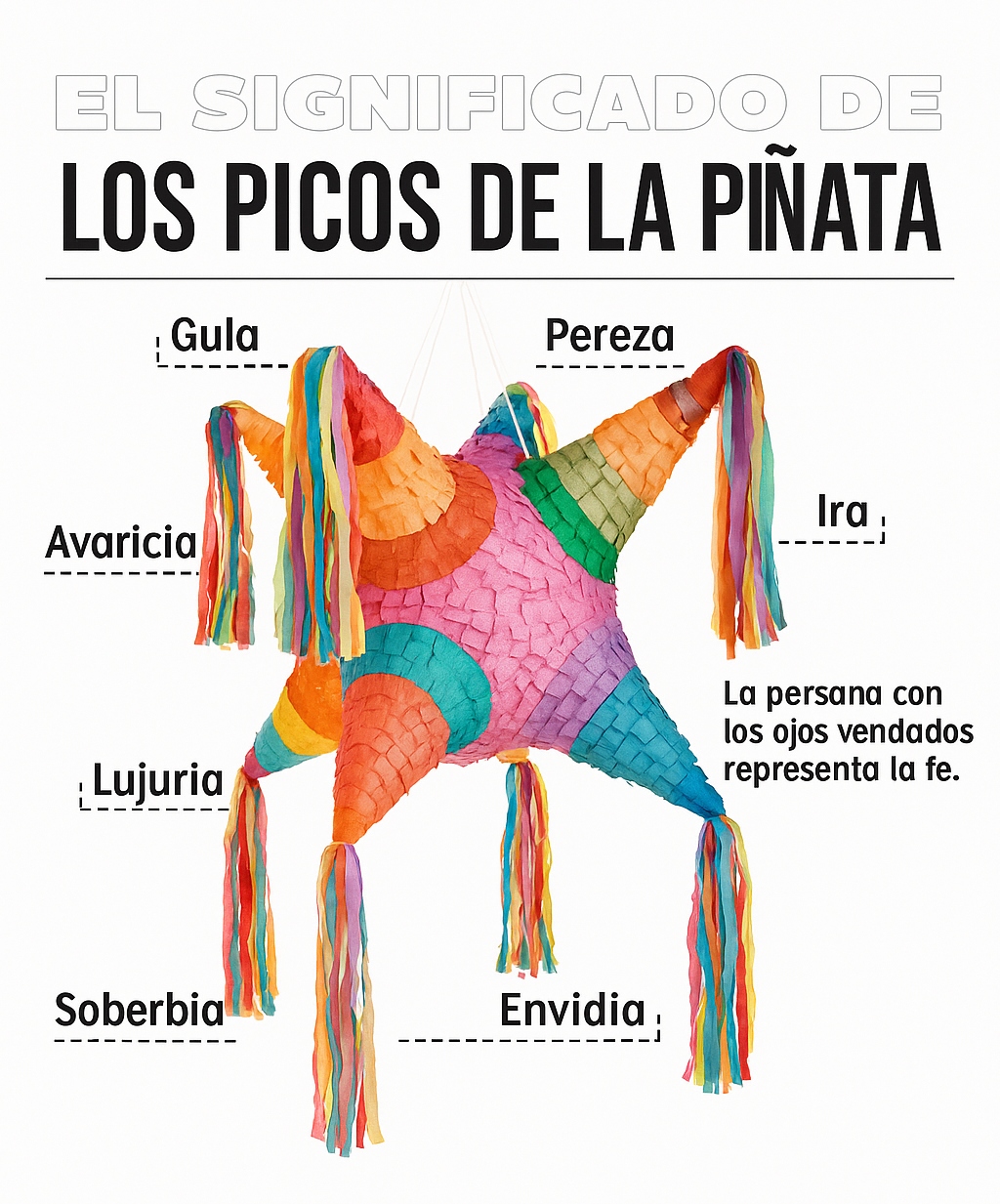
The traditional Posadas piñata has seven spikes, symbolizing the seven deadly sins: pride, greed, lust, anger, gluttony, envy and laziness.
Its colorful and attractive shape represents temptation, that which seems harmless but can deviate from the right path.
Breaking the piñata symbolizes overcoming evil and temptations, while the falling candy and fruit represent the spiritual reward for keeping the faith and acting righteously.
The symbolism of the ritual
#DidYouKnowWhat | Each #piñata is a handcrafted work of art made by families who keep this Mexican tradition alive. 🪅
Their elaboration requires creativity, patience and lots of color to fill our posadas with joy. 🎄 pic.twitter.com/tKpSFTsp0s
– Central de Abasto CDMX (@CdeAbastoCDMX) December 8, 2025
Each element of the ritual has a meaning:
The blindfold symbolizes faith, acting without seeing, trusting in what is right.
The stick or staff represents spiritual strength to face evil.
Traditional singing reinforces the sense of community and the oral transmission of tradition.
Collective participation is a reminder that faith and culture are lived in community.
This symbolism transforms what appears to be a simple game into a cultural and spiritual lesson, passed down from generation to generation.
From religious to cultural
Follow the tradition! 🪅🎉 Christmas piñatas are the heart of the posadas, as they have a religious meaning like the 7-pointed ones; this is what the artisans say 👇
Via @LizieRodriguez pic.twitter.com/kJ0Epk5nE5
– TV Azteca Puebla (@aztecapuebla) December 15, 2025
Over time, the piñata transcended the religious sphere and became a cultural symbol present at birthdays, school celebrations and community events.
However, during the Posadas, the seven-cornered piñata retains its original meaning, especially in family and community contexts.
In the United States, many Mexican families explain to their children the meaning of the piñata, as a way to connect with their roots and give value to the tradition beyond the candy.
For Hispanics living in the United States, the piñata is a cultural bridge.
It adapts to new spaces – courtyards, parks, churches or community centers – but maintains its essence.
Teaching its symbolism helps new generations understand that the Posadas are not just a party, but an expression of identity.
In addition, in a multicultural environment, the piñata has become a recognizable symbol of Mexican culture, generating curiosity and respect for its traditions.
Much more than a game
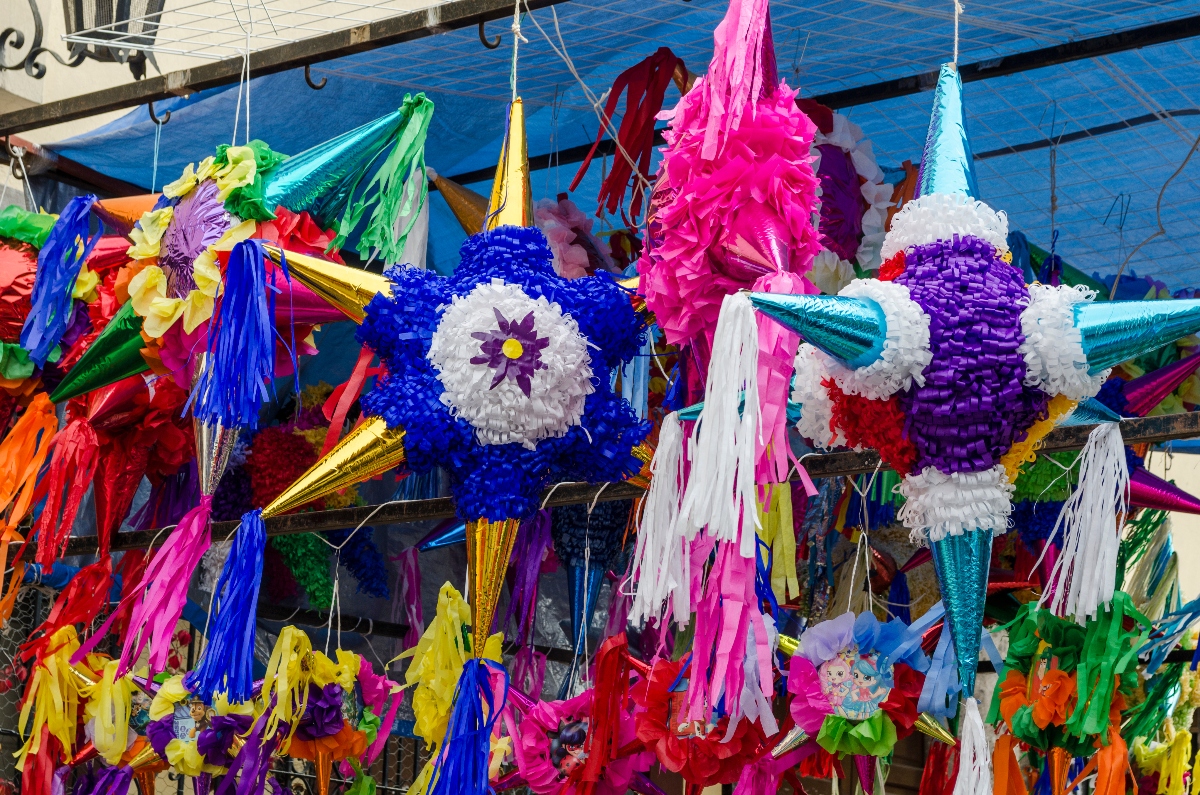
The seven-cornered piñata is not just a festive object.
It is a tangible representation of history, faith and community values.
Understanding its meaning allows the Posadas to be experienced more deeply and the tradition to continue, even far away from Mexico.
For those who celebrate Posadas in the United States, breaking the piñata is also a way to break the distance and keep alive the connection to their culture and history.