




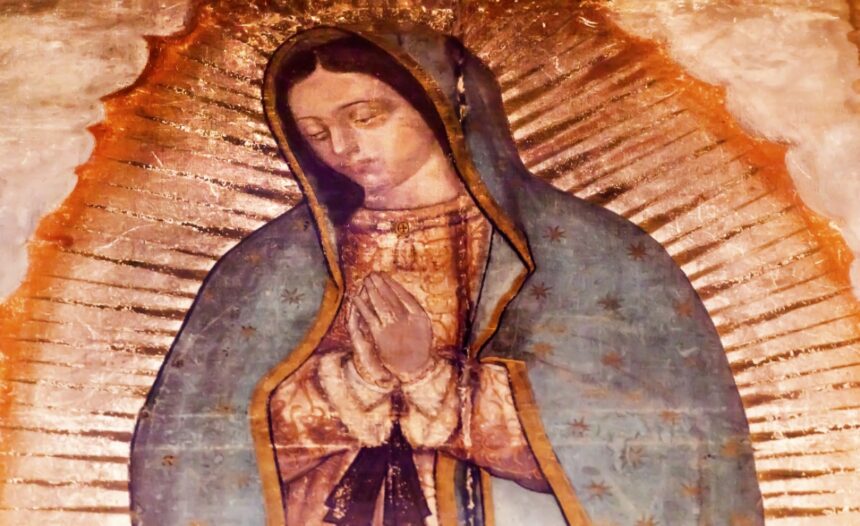
Few works in the history of the continent have been examined as many times as the tilma of Juan Diego, the image of the Virgin of Guadalupe that millions of believers have venerated since 1531. For more than a century, laboratories, scientific photographers, restorers and experts in pigment chemistry have tried to answer a central question:
What are the colors that make up the image made of? The short answer is surprising: there is no clear scientific consensus, but there is verified data that allows us to better understand what is known… and what remains a mystery.
1. No traces of pigment visible on the tilma.
🌹Between December 9 and 12, 1531, the Virgin of Guadalupe appeared to Saint Juan Diego at Tepeyac ✨.
In 1945, Pope Pius XII proclaimed her “Queen of Mexico and Empress of America.
🌹 In 1999 St. John Paul II declared her “Patroness of all America.”✨ pic.twitter.com/AVkFPOhCEY
– DianaM🇺🇲❤️🔥🇲🇽 (@DianaMargot_) December 11, 2025
One of the most cited discoveries comes from the study by Richard Kuhn, Nobel Prize winner in Chemistry, who analyzed fibers from the tilma at the request of the Church in the 20th century.
His conclusion: the pigments do not correspond to vegetable, mineral or animal dyes known in 16th century works.
Other analyses, including studies with infrared light, detected that the image lacks superimposed brushstrokes, something unusual for a painting of the time. Although the Church clarifies that this does not prove a miraculous origin, it does make it a unique case for art historians.
2. The colors do not show normal deterioration for a 16th century work.
The tilma is made of ayate, a maguey fiber that, under normal conditions, should last between 15 and 40 years before disintegrating.
However, the fabric has survived almost 500 years, exposed for centuries to candle smoke, human manipulation, humidity and contamination.
In analyses conducted in the 1970s, experts pointed out that:
The colors have not crackled as is the case with old paintings.
There is no traditional preparation coat, such as primers or sealers.
The pigmentation remains adhered to the fiber without evident detachment.
These findings are puzzling conservation specialists because they do not coincide with the normal behavior of colonial paintings.
3. There are later additions (but the central image remains intact).
Miracle or science? 🤯
The Tilma of the Virgin of Guadalupe continues to reveal secrets 500 years on New research has unearthed findings that defy logic: 🎵 Music:
Do stars and flowers hide musical notes that form a melody? ✨ Astronomy: The 46… pic.twitter.com/0PlJVTPz8Z
– Fuerza Informativa Azteca (@AztecaNoticias) December 12, 2025
Something important and fully documented: the image has received later additions, especially in the seventeenth century.
Studies confirm that: The little angel and the golden rays show pigments typical of Mexican Baroque. The border of the mantle was also retouched in later centuries. The image of the face, hands and dress show no detectable repainting.
This makes it possible to distinguish between the original work (which remains scientifically baffling) and decorative elements added by colonial artists.
4. Natural pigments, mineral powder or something not yet classified?
Researchers such as Philip Callahan, a NASA biophysicist, concluded after photographic studies that the pigments of the tilma fluoresce differently from those of traditional paints.
It has not been possible to classify the composition with the techniques used so far, although specialists warn that the lack of direct samples limits the results.
What is conclusive: Science has not identified a conventional pictorial method in the central image.
Not detected: Oils, Tempera, Common mineral pigments, Animal or vegetable binders.
The exact origin of the colors remains to be fully explained.
Why does this issue matter for Latinos in the U.S.?

For many devotees, mystery is not a problem, but a source of faith.
But even for those who approach it from a scientific or historical perspective, the tilma is a cultural document that reveals the unique blend of indigenous and Christian traditions that gave birth to Mexico and that today form an essential part of Latino identity in the United States.
In a country where millions of immigrants seek roots, stability and a sense of belonging, the Virgin of Guadalupe remains a unifying symbol.
To understand the history behind its pigments is, in part, also to understand how it built an identity that stands the test of time.
Filed under: Pigments of the tilma of Juan Diego