





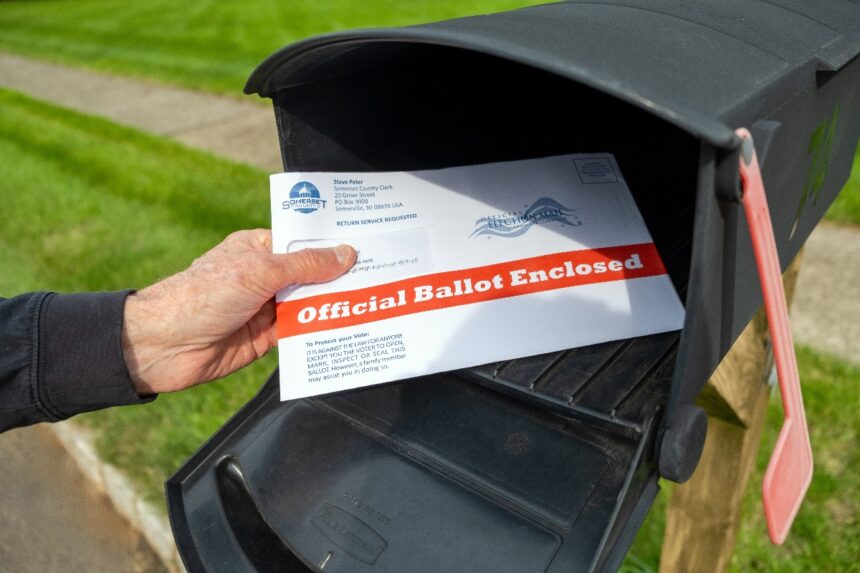
The specter of 2020 has returned to the White House, but this time with a pen in hand and the power of the executive branch backing it up. This Tuesday, President Donald Trump made official an executive order drastically restricting absentee voting in federal elections, a move that promises to be the epicenter of an unprecedented legal and social battle ahead of the November polls.
Under the argument of shielding democracy against “possible fraud” – a discourse he has kept alive since his defeat by Joe Biden – Trump has instructed his new Secretary of Homeland Security, Markwayne Mullin, to take the reins of electoral surveillance. The centerpiece of this strategy is the creation of a new federal registry of eligible voters, drawn up in direct collaboration with the Social Security Administration.
Federal control or electoral barrier?
Donald Trump signs order creating national voter list and restrictions on absentee voting – https://t.co/MjKRuNUIKI
– José A. Delgado (@JoseADelgadoEND) April 1, 2026
During the signing ceremony, Trump was blunt: “We’re going to take federal data and make sure that officials in every state have a complete picture of who the eligible voters are.”
In practice, this means that the White House will have a say in who qualifies to receive a ballot on their doorstep.
To critics, this is a clear attempt at voter suppression, especially in communities that rely on the postal system for lack of transportation or time.
For Republican supporters, it is the necessary “cleansing” of a system they consider vulnerable.
The truth is that, to date, there is no substantial evidence of massive fraud in the absentee vote, but the Trump narrative continues to mobilize masses.
The return of the “Citizenship Test”.
Trump signed an executive order restricting absentee voting nationwide and mandating citizenship verification for federal elections.https://t.co/nAYbDC1Fgy
– NMás (@nmas) March 31, 2026
The executive order does not travel alone.
The administration is pushing Congress to pass a law requiring strict identification as “proof of citizenship.”
While 36 of the 50 states already require ID to vote, Trump’s proposal would raise the requirements to a federal level that many consider a bureaucratic hurdle designed to filter the electorate.
A climate of maximum tension
🚨 URGENT: President Trump has SIGNED an executive order BANNING the use of vote-by-mail voting nationwide.
This MUST go into effect before the midterm elections. An ANTI ELECTION FRAUD measure until the SAVE America Act is passed 🇺🇸 EXCELLENT!. pic.twitter.com/rBfOUGQecu
– Eduardo Menoni (@eduardomenoni) March 31, 2026
We cannot forget that this rhetoric about the insecurity of the ballot box was the fuel that led to the assault on the Capitol in January 2021.
With this new order, the political temperature in Washington has reached boiling point.
Civil rights organizations are already preparing lawsuits, claiming that a president does not have the constitutional authority to centralize in this way a process that, by law, belongs to the states.
Absentee voting, which was vital during the pandemic and has grown in popularity, is now in the spotlight.
The big question is: will this executive order succeed in changing the November outcome or will it only deepen the divide in an already fractured country?
Do you think this measure really protects the vote or is it just a political strategy to limit participation?
Filed under: Executive order absentee voting