



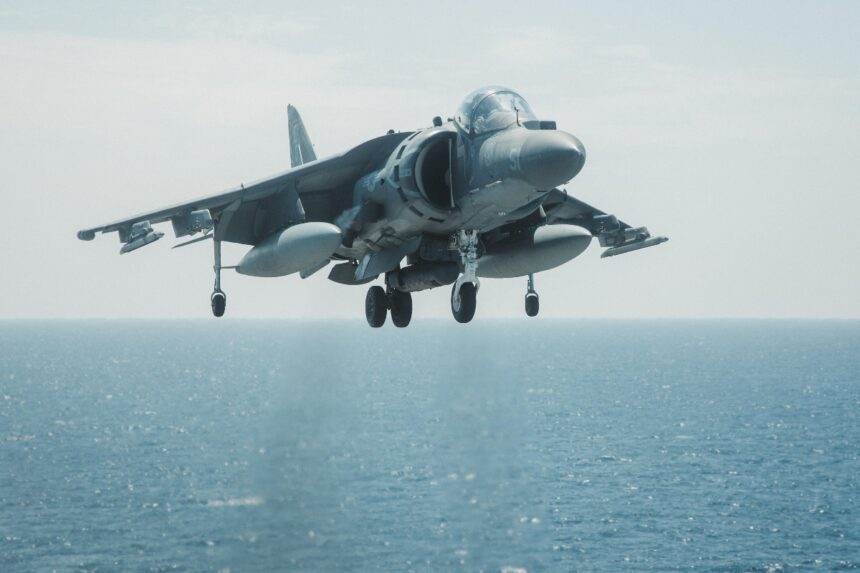
The U.S. Army on Wednesday released a series of photographs showing Marines conducting rifle exercises on the deck of the amphibious ship USS Iwo Jima, deployed in the Atlantic Ocean off the Venezuelan coast.
The images, released by the Defense Department’s audiovisual service, show complete maneuvers: soldiers pointing rifles, technicians checking naval machinery and the operation of aircraft from the ship.
Photos of U.S. military deployment near Venezuela
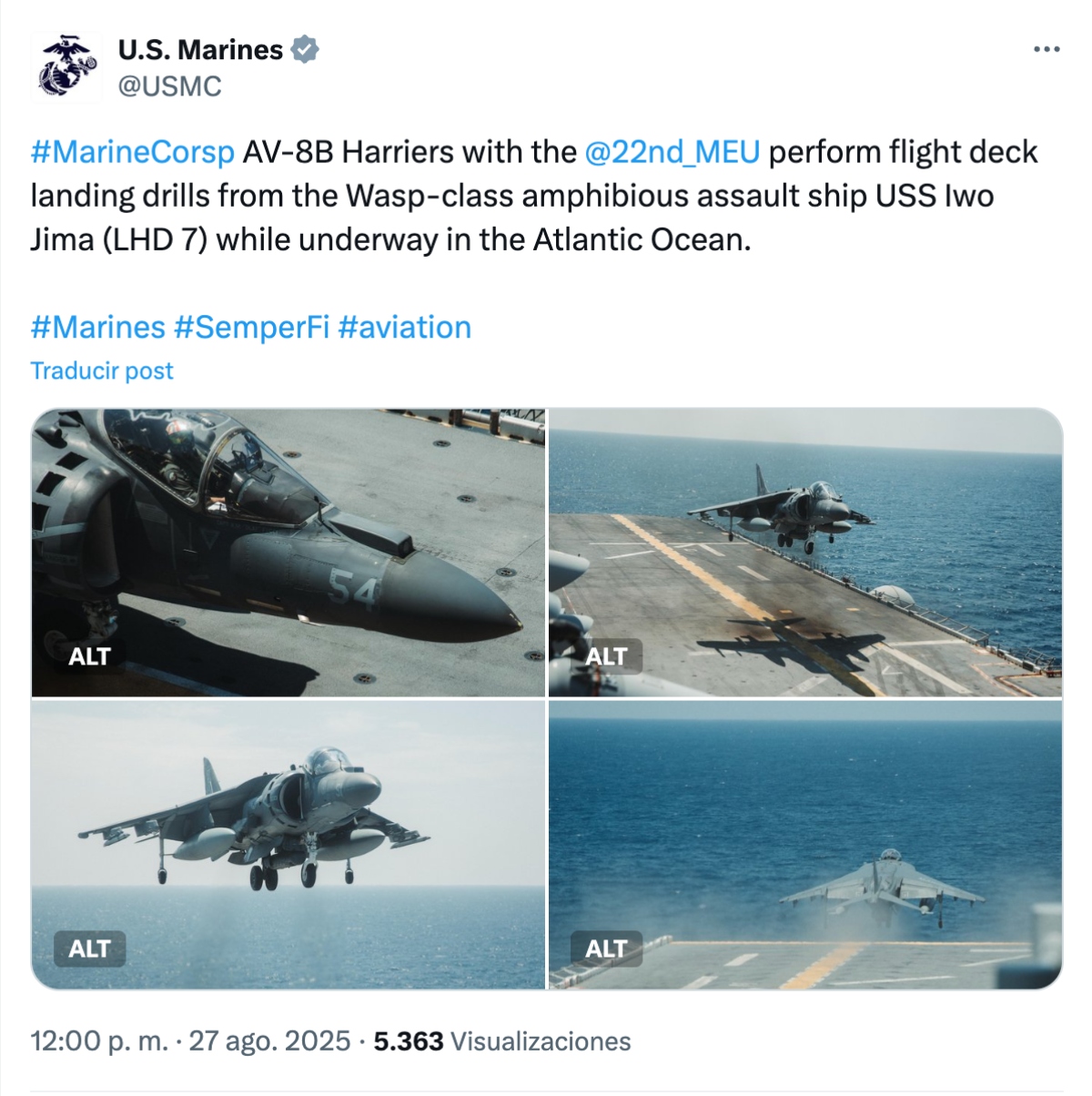
This deployment is not limited to Iwo Jima.
It includes a significant naval force: the destroyers USS Gravely, USS Jason Dunham and USS Sampson, along with amphibious ships such as USS San Antonio and USS Fort Lauderdale.
There are an estimated 4,000 to 4,500 military personnel, including some 2,200 Marines, plus P-8A Poseidon surveillance aircraft and a nuclear attack submarine in close operation.
The U.S. government claims that its mission is the fight against drug trafficking, in which Venezuela has been identified as a key point in drug shipment routes to the U.S. The U.S. government claims that its mission is the fight against drug trafficking, in which Venezuela has been identified as a key point in drug shipment routes to the United States.
The dispatch of this naval force follows the designation of cartels as terrorist organizations.
As well as following the increase of the US$50 million reward for information leading to the capture of President Nicolás Maduro.
Venezuelan reaction: massive mobilization and firm rejection
Faced with this escalation, the Venezuelan government responded forcefully.
President Nicolás Maduro described the deployment as an attempt at illegitimate and “illegal” regime change.
Maduro announced the mobilization of 4.5 million members of the Bolivarian militia as an internal defensive measure.
Defense Minister Vladimir Padrino also ruled out that Venezuela has reason to fear and cited examples of recent operations.
First, he mentioned the capture of more than 2,800 kilos of cocaine.
In addition to the deployment of ships and drones in coastal areas.
And also the increase of military control at border points as a response to what he has called imperial aggression.
What does this mean for the U.S. Hispanic community?
Regional and geopolitical impact: This military deployment is one of the most significant U.S. deployments in the Caribbean in recent years, with implications not only in the fight against drugs but also in tensions with actors such as Russia, China and Iran.
Humanitarian and political concern: A military escalation could lead to additional refugees or tensions. Any escalation could affect Latino and Venezuelan communities residing in the U.S., which already face uncertainty and political pressure.
Key information for families: It is recommended to be attentive to official sources (State Department, Spanish-language press, consulates) for updates on travel alerts, possible sanctions or immigration measures that may affect them.
There are an estimated 4,000 to 4,500 military personnel, including some 2,200 Marines, plus P-8A Poseidon surveillance aircraft and a nuclear attack submarine in close operation
QueOnnda.com