



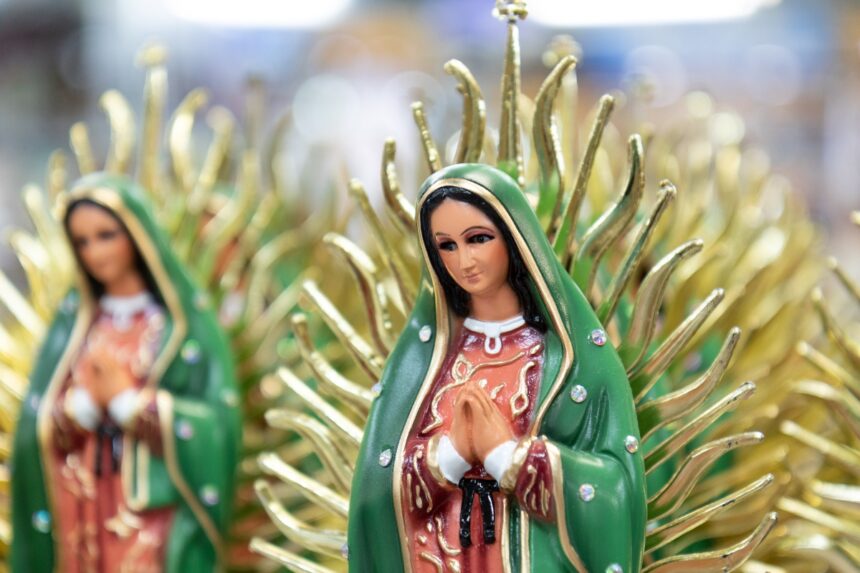
Although millions of devotees in the United States and Latin America venerate the Virgin of Guadalupe every December 12, very few have noticed one of the most important and revolutionary details of her image: the Virgin is pregnant.
This feature, perfectly visible on Juan Diego’s tilma, is neither casual nor decorative; it is one of the most profound theological, cultural and historical symbols of all Guadalupanism.
How do we know that the Virgin of Guadalupe is pregnant?
The key element is the black bow tied around her waist.
For the indigenous peoples of central Mexico in 1531, this ribbon was an unmistakable sign: it represented a pregnant woman.
In the Nahuatl tradition, the ribbon -called tocuitl- was placed over the belly to indicate that the woman was expecting a child.
For this reason, when the indigenous people saw the image for the first time, they immediately understood that the woman who appeared in the ayate had life inside her.
This detail becomes even more significant when the context of the time is understood.
In 1531, barely ten years after the fall of Tenochtitlan, the indigenous communities were experiencing a profound cultural, social and spiritual crisis.
The figure of a pregnant divine woman -not a warrior, not a punisher, but a protector and bearer of life- represented a completely different message from that of the pre-Hispanic gods associated with war and sacrifice.
Message to 2 worlds
For the Spanish, on the other hand, the image was a Marian representation that announced the birth of Jesus.
Thus, the tilma spoke simultaneously to two conflicting worlds.
The position of the body also reinforces this message.
The Virgin is neither rigid nor in a solemn pose; her posture is slightly inclined, as one who listens, understands or consoles.
For researchers in sacred art, this inclination is a sign of maternal closeness.
The belly appears softly bulging, and the tunic falls naturally over it, reinforcing the interpretation of pregnancy.
The flower with 4 petals, a sacred element
Another fundamental element is the four-petaled flower, known as nahui ollin, located on its belly.
This symbol was extremely sacred in the indigenous cosmovision, as it represented the center of the universe, life, movement and the presence of the divine.
For the native peoples, seeing it on the Virgin’s womb meant that the being inside was the true “God of heaven and earth”. For the Christian tradition, it was a representation of the Child Jesus.
In the Hispanic community living in the United States, this detail takes on a powerful meaning.
For many immigrant mothers, the pregnant Virgin is a symbol of hope, family protection and strength in times of uncertainty.
In states such as California, Texas, Illinois and New York, it is not uncommon to see Guadeloupean images with emphasis on the belly or black ribbon, especially in clinics, community centers and homes of young families.
Her pregnancy not only explains why millions of Catholics see the Virgin of Guadalupe as the Mother of life and consolation, but also connects new generations with a universal message: in the midst of difficulties, there is always a source of hope.
Filed under: Virgin of Guadalupe pregnant