





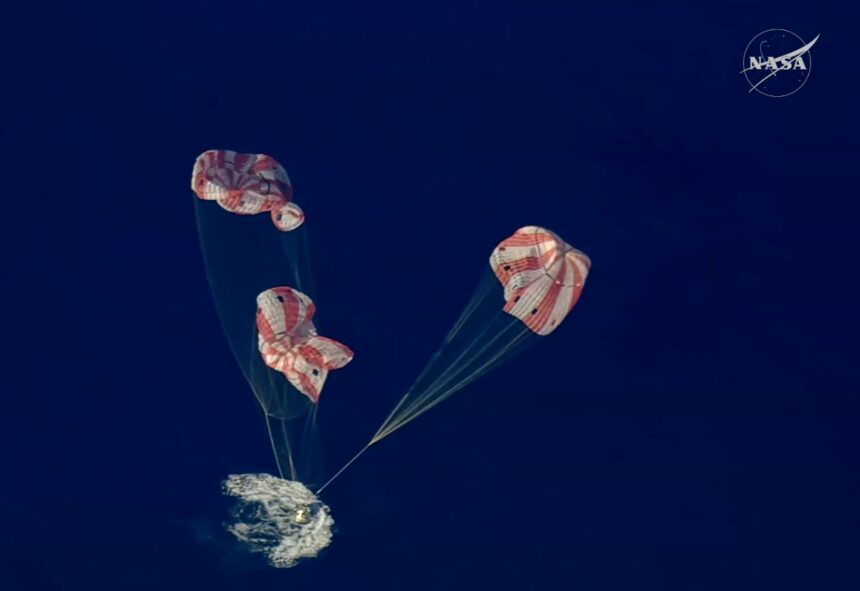
Artemis II successfully completed this Friday its mission to take humans back to lunar orbit for the first time since 1972, with the departure of the Orion capsule of its four astronauts, in apparent good condition and amid applause from the control center in Houston, after ten historic days and without major mishaps.
“The United States has once again sent astronauts to the Moon and brought them back safely,” NASA Administrator Jared Isaacman said after splashdown about this test mission of the powerful SLS rocket and Orion spacecraft.
Artemis II returns to Earth
Orion’s main parachute has deployed. The spacecraft has a system of 11 chutes that will slow it down from around 300 mph to 20 mph for splashdown.
Get more updates on the Artemis II blog: https://t.co/7gicm7DWBt pic.twitter.com/ReXHTfkFld
– NASA (@NASA) April 11, 2026
Good weather accompanied the more diverse crew that reached lunar orbit last Monday after a smooth liftoff April 1 from Cape Canaveral, Florida, conditions that were repeated Friday in the Pacific off the coast of San Diego, California, where the capsule dove.
Victorious to Earth were the first woman to orbit the Moon, Christina Koch; the first African-American, Victor Glover; and the first non-American to accompany a NASA mission, Canadian Jeremy Hansen.
NASA commander Reid Wiseman completed this mission, which comes to an end with a host of historic milestones accomplished and will give a boost to the upcoming Artemis Program missions that seek to land on the moon twice in 2028, as well as orbit the Earth in 2027, while the U.S. space agency simultaneously moves forward with plans to build a base on the Moon.
The crew surpassed the distance record achieved in space by the Apollo 13 mission in 1970 and set a new mark by moving 406,771 kilometers away from Earth.
It also tested human life support on a spacecraft for the first time by passing over the far side of the Moon, which included a 40-minute communications blackout and rewarded them with an eclipse of more than 50 minutes, which allowed them to make other types of observations.
NASA said that it will now have to analyze the abundant graphic material collected and the observations made, which will serve as a basis for guiding future Artemis program missions.
Fire, Nutella and a farewell in the stars
Welcome home Reid, Victor, Christina, and Jeremy! 🫶
The Artemis II astronauts have splashed down at 8:07pm ET (0007 UTC April 11), bringing their historic 10-day mission around the Moon to an end. pic.twitter.com/1yjAgHEOYl
– NASA (@NASA) April 11, 2026
During the expedition, Wiseman had one of the most emotional moments, when his companions named a lunar crater observed for the first time by humans ‘Carroll’, in honor of his deceased wife.
A jar of Nutella – sweet hazelnut and cocoa cream – floating during the live broadcast, along with the toilet clogging and foul odors the astronauts had to endure, marked the funniest and, at the same time, most unpleasant moments of the mission.
Test passed, next stop: Mars
Big smiles from Christina and Victor on the deck of the USS John P. Murtha, as they waited to be escorted for their routine post-mission medical checks. pic.twitter.com/3KwZFXTLhI
– NASA (@NASA) April 11, 2026
The astronauts concluded Friday a journey with significant risks, from liftoff – which could have compromised the rest of the operation – to re-entry, especially since it was the first crewed test of the Artemis II heat shield.
This shielding was able to protect the crew from the high temperatures generated by friction during re-entry into the Earth’s atmosphere, which were estimated to range from 1,650 degrees Celsius (3,000 Fahrenheit) to about 2,760 degrees Celsius (5,000 Fahrenheit).
This heat was generated by entering the Earth’s atmosphere at a speed approaching 40,000 kilometers per hour (about 24,661 miles per hour), with deceleration reaching up to four times the force of gravity.
The astronauts were recovered by U.S. military and NASA personnel, who transferred them to an inflatable platform.
From there, they were scheduled to be evacuated by helicopter and transferred to a ship’s infirmary, where they will continue with medical evaluations, before being transferred to land for further examinations.
“We are returning to the Moon. We’re doing it to stay,” said an excited Isaacman, who went to accompany the astronauts’ rescue in the Pacific.
“We’re going to master the skills on the lunar surface so that we can someday undertake missions to Mars. It’s an incredibly exciting time. And we’re not going alone: we’re taking everyone with us,” Isaacman added.
Filed under: Artemis II returns to Earth
With information from EFE