




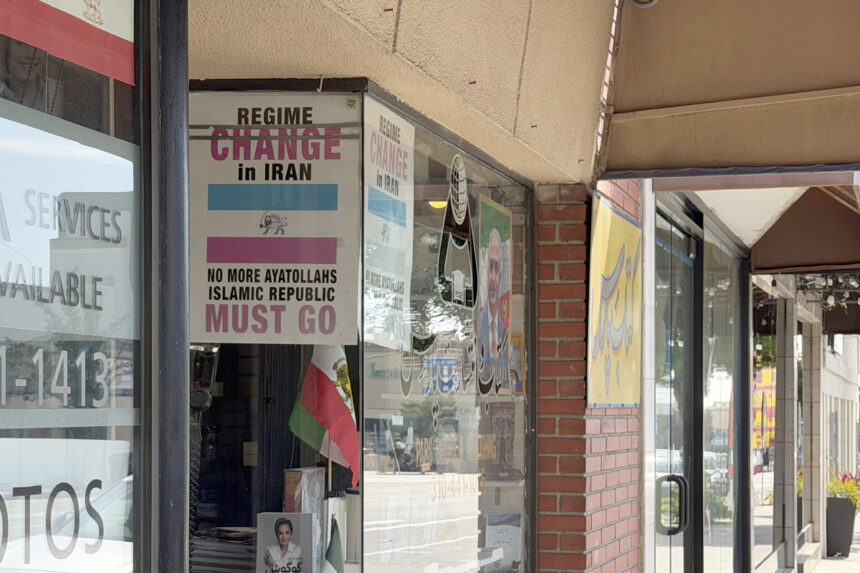
Walking down Westwood Boulevard today is not like any other Wednesday. In the coffee shops of ‘Tehrangeles’, the aroma of saffron and Turkish coffee mixes with an electric tension. After news of the bombing that took out the “head of the snake” – as some residents call Ayatollah Ali Khamenei – the most Iranian neighborhood outside Iran is torn between euphoria and panic about what’s to come.
For figures like Roozbeh Farahanipour, who traded torture cells in Tehran for business in L.A., this is the moment they have been waiting for decades. However, the generation gap is evident: while the older ones display pictures of the Shah’s son, the younger ones, born in California, demand a real democracy, far from the ghosts of the past and the bullets of the present.
Tehrangeles, the largest community of Iranians in the United States, is eagerly waiting for the dream of liberation they have had for decades to come true and for the population to rise up against the Iranian regime, weakened after the death of the supreme leader, Ayatollah Ali Khamenei, in the war initiated by Israel and the United States.
“We are all excited and have celebrated the removal of the head of the snake,” Roozbeh Farahanipour, executive director of the West Los Angeles Chamber of Commerce, tells EFE about the death of Iran’s top leader in a bombing last Saturday.
But amid the “happiness” of this community, Farahanipour, who was imprisoned and tortured after the 1999 student protests in Iran, stresses the need for the Iranian people “to be able to change the regime” themselves.
Since his arrival in the United States in 2000 as an asylee, Farahanipour has continued his work to bring about a democratic and secular government in Iran.
“Now is the time to take charge of your own destiny before another country comes to write it for you,” he says in his message to Iranians.
Tehrangeles, a neighborhood of opportunities
Tehrangeles is in the heart of Westwood, and is the heartbeat of Iranian & Persian culture in Los Angeles and the United States.
I wondered how it came to be so I checked it out.
Let’s get into it!
(Original episode air date: September, 2022) pic.twitter.com/Nz7iwXxO2o
– L.A. in a Minute (@LaInaMinute) March 2, 2026
Farahanipour owns two restaurants in the West Los Angeles neighborhood known as ‘Tehrangeles’, an area so named after many Iranians settled in the area in the 1960s.
After the 1979 Islamic revolution in Iran, new migrants arrived in the area where they opened restaurants and businesses that help connect Iranians to their roots.
Between 400,000 and 620,000 people of Iranian descent live in the United States, the vast majority of them in Los Angeles, according to figures from the University of California Los Angeles (UCLA).
In 2019, more than half of Iranian immigrants in the U.S. lived in California, and 29% (nearly 140,000 people) lived in Los Angeles County alone, according to the Migration Policy Institute (MPI).
Farahanipour says he has found in ‘Tehrangeles’ a place of work opportunities, but also a space where he has been able to express his opinions without fear of losing his life, a right he would like the people of Iran to be able to have.
Longing for democracy
Tehrangeles, the nickname for the LA neighborhood that is a hub of Iranian-American businesses and homes, erupted in noisy celebration on Saturday.
“This is a Berlin Wall moment, or perhaps even a D-Day type moment,” said Sam Yebri, a Los Angeles attorney who is active in…
– POLITICO (@politico) March 1, 2026
The activist’s yearning for the people of Iran to be in charge of electing their new government is echoed by almost all residents of this neighborhood.
Farahanipour does not express support for any opposing force to the current government, but other members of the community support Reza Pahlaví, the eldest son and heir to the Iranian shah deposed in 1979 by the Islamic Revolution.
Pahlavi, 65, also a resident of the United States, has offered to head a new government in Iran, although U.S. President Donald Trump is skeptical of the possibility.
“He (Pahlavi) is the one,” Beigzadeh, who runs one of several businesses displaying a photo of the shah’s son on Westwood Boulevard, the main street in this neighborhood, told EFE.
But not everyone agrees.
Fatima, a young American woman of Iranian parents who did not want to reveal her last name, believes that after nearly 50 years under the ayatollahs, a “new generation of leaders” away from any previous government is important.
“We all want a democracy for Iran, but it must be a real democracy, not a facade,” insists the California-born young woman.
She is also concerned about her parents’ relatives, with whom they have not been able to communicate since the attacks began last Saturday.
Fatima expresses her dissatisfaction with the war.
“There are too many dead, I think they should have acted in a more calculated way. This could turn into a very long war,” she says in a low voice to avoid being overheard by the employees and customers of the café where she is.
More than 1,000 people have been killed in bombing raids against Iran and at least six U.S. military personnel have died in the strikes with which Tehran has responded.
Farahanipour shares the young woman’s concern.
The activist and businessman hopes that “this war will not last so long” and no more Iranian or American lives will be lost.
In addition, as a good businessman, he is concerned about the money that the confrontation may cost.
With information from EFE