





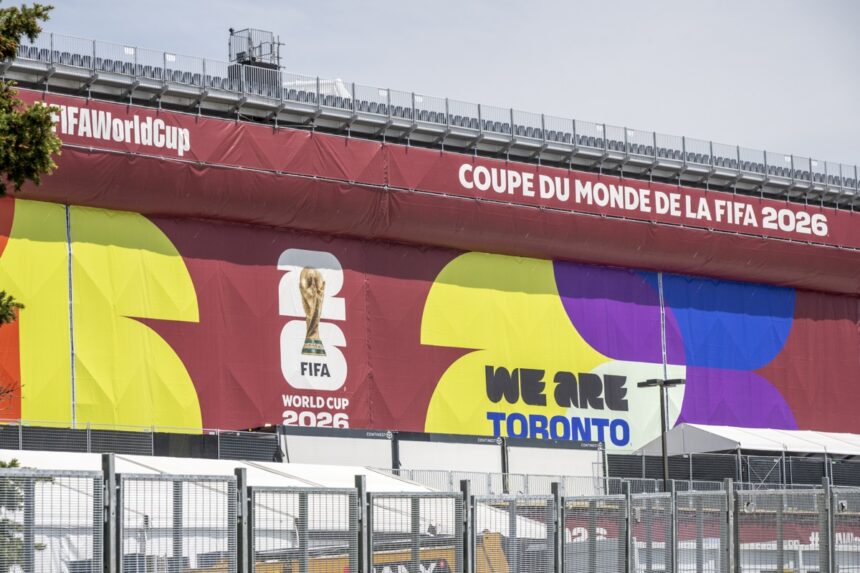
When talking about the 2026 World Cup, the focus is usually on the United States, for its huge infrastructure and political prominence, or Mexico, for its historic soccer passion. However, Canada will also host the biggest tournament in FIFA’ s history and will do so in its own way: with discretion, efficiency and a multicultural identity that promises to offer a different experience to millions of fans.
For the first time, Canada will host the 2026 World Cup. Although it will share the organization with the United States and Mexico, its role will be much more modest. Of the 104 matches scheduled for the tournament, only 13 will be played on Canadian soil: seven in Vancouver and six in Toronto. Moreover, none of these cities will host matches from the quarterfinals onwards.
A generation that changed history
#Soccer2Day – 🇨🇦
The 26 chosen by Jesse Marsch 🇺🇸 who will represent Canada, one of the 3 locals in this World Cup 2026🇺🇸🇨🇦🇲🇽
In the selection led by Alphonso Davies, Jonathan David and Tajon Buchanan, highlights the inclusion of Marcelo Flores, in addition to Owen Goodman… pic…twitter.com/UTQhkz0Gk6
– Luis Omar Tapia (@LuisOmarTapia) May 30, 2026
Despite having limited participation compared to its organizing partners, soccer is currently experiencing one of its best moments in Canada.
The men’s national team has experienced remarkable growth in recent years and has managed to position itself once again on the international stage after qualifying for the 2022 World Cup in Qatar, its first World Cup appearance in more than three decades.
Much of this transformation has its own names.
Alphonso Davies, Bayern Munich star and captain of the Canadian national team, has become one of the most recognized players on the planet.
He is joined by Jonathan David, a striker who has attracted the interest of some of Europe’s top clubs thanks to his goalscoring ability.
The development of academies, professional clubs and the country’s increasing cultural diversity have fueled the growth of soccer.
In Canada, where more than one-fifth of the population was born outside the country, the sport has become a meeting point for communities from Latin America, Europe, Africa and Asia.
Costs, criticisms and opportunities
🏟️ This is what Vancouver, Canada’s host city for the 2026 World Cup, looks like.
🇨🇦 Vancouver, one of Canada’s two host cities for the 2026 World Cup, will host the tournament as a showcase for a compact, diverse city open to the Pacific, marked by its landscape of mountains, sea, skyscrapers and… pic.twitter.com/ioFpssb1Xf
– El Universal (@El_Universal_Mx) June 5, 2026
The organization of the World Cup has also generated debate.
Local authorities have acknowledged that infrastructure, logistics and security costs will be significantly higher than initially estimated.
In cities such as Toronto and Vancouver, some sectors are questioning public investment in the tournament while challenges related to access to housing, cost of living and social services persist.
However, supporters of the event argue that the World Cup will offer significant economic benefits, boost tourism and project a positive image of Canada to billions of viewers around the world.
A different kind of host
Multicultural pride grows in Canada as World Cup approacheshttps://t.co/wtZrSbjuTI
– CNN en Español (@CNNEE) June 7, 2026
Unlike other countries that turn major sporting events into demonstrations of national pride, Canada seems to be opting for a more sober strategy.
Its preparations have focused on improving infrastructure, optimizing transportation and ensuring the safety of visitors and residents.
Away from the spotlight of New York, Los Angeles or Mexico City, Canada is preparing to play a role commensurate with its international reputation.
To be an efficient, multicultural and organized host that will contribute to the success of the 2026 World Cup without the need to become the center of attention.
Filed under: Canada host World Cup 2026