





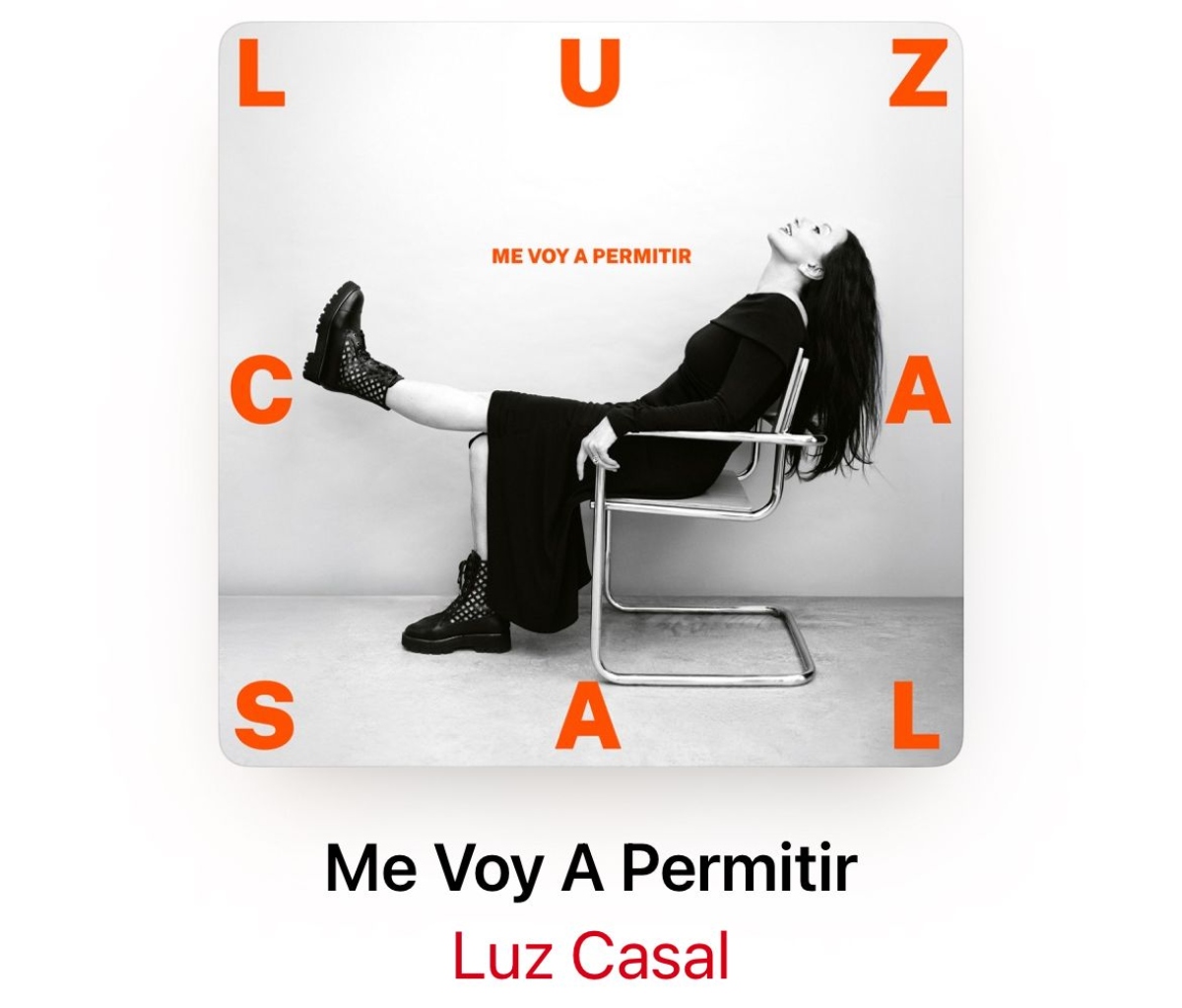
Spanish singer Luz Casal releases this Friday ‘Me voy a permitir’, another eclectic exercise of freedom, which, although conceived as a tribute to the women who inspire her in music, has a lot of personal vindication and shows the immense desire to enjoy and to prove herself that she still retains.
“I have always been a person eager to see and to know, but above all I have taken pleasure in life as a result of having health problems. I said to myself: ‘I’m not going to waste this opportunity,'” he says in a conversation with EFE about some of his new lyrics, in which he reproaches those who are “tired of watching life go by through the window.
As if it were a compilation, but without being so, with five new songs and five versions, she exhibits in her work ‘Me voy a permitir’ all those facets that have made her, among other things, a National Prize of Current Music.
“It’s what I’ve been doing all my life, which is to allow myself to be free and do whatever I feel like doing at any given moment for a very simple reason: I can’t do what I don’t feel,” says Casal (1958).
This work also offers a tribute to the Portuguese Amalia Rodrigues with the fado ‘Lágrima’ or to the classic Latin American repertoire, such as ‘Bravo’, popularized by Olga Guillot among others, or ‘Todo cambia’, sung by Mercedes Sosa.
“Many times I have had the feeling that more importance is given to the interpreter who sings his own songs and I think that difference in appreciation should not exist, because there are thousands of examples where a particular interpretation made a song a success,” he explains about the genesis of the project.
As she began to cover powerful songs sung by women, she came up with her own ideas for completely new songs, such as ‘El blues de la cebolla’, an original composition by Chris Barron (Spin Doctors), produced by Paul ‘Wix’ Wickens (Paul McCartney’s regular musician) and to which she wrote the lyrics in Spanish.
When she finished it, she realized that it was a vindictive song, “but it wasn’t premeditated”, she justifies about a dimension that other tracks have, like the one that gives title to the album when she sings: “I’m going to open my mouth, tell the idiot what I think of him”, one of the most rock and feminist songs of the album.
There she also sings: “I don’t want to fit into what you define as an ideal world / I prefer to change the rules of the game, not to be one more”.
“I don’t have the feeling of being a Joan of Arc. I have moved in a world with certain slogans that I have skipped out of necessity for survival and I have been solving the difficulties by gender, by style or whatever, as they have arisen,” she says modestly about her legacy.
To round off the album (“It represents quite a lot of who I am, but I want to think that not everything because I hope to keep discovering things”, he points out), he also covers Charles Aznavour’s mythical ‘She’ with an unexpected but very “effective” companion, Carla Bruni, who in his opinion adds “sensuality” to the song and the necessary French flavor and context with which the song was originally composed.
“It was very professional, very beautiful, very simple and very loving,” she recalls about recording with this composer and performer, whose presence she defends in this feminist album despite being married to the conservative former president Nicolas Sarkozy.
“On a sentimental level, she has shown enormous looseness in falling in love with the son and the father, which we could say is almost a transgression,” he says.
On January 2, reported Agencia EFE, the tour begins in Toledo (Spain) and will continue to other places such as Paris (January 10) and Madrid (January 17).
Find out more at ‘QueOnnda.com’.