






In September 2025, the Supreme Court of Justice of the Nation (SCJN) established a definitive and mandatory criterion: victims of child sexual abuse will be able to demand civil compensation without time limit, even when criminal action is no longer possible.
This resolution was unanimously adopted by the First Chamber of the highest court, establishing a new and powerful legal precedent.
This criterion is derived from the legal case of singer Sasha Sokol, who sued producer Luis de Llano for sexual abuse that occurred when she was 14 years old and he was 39.
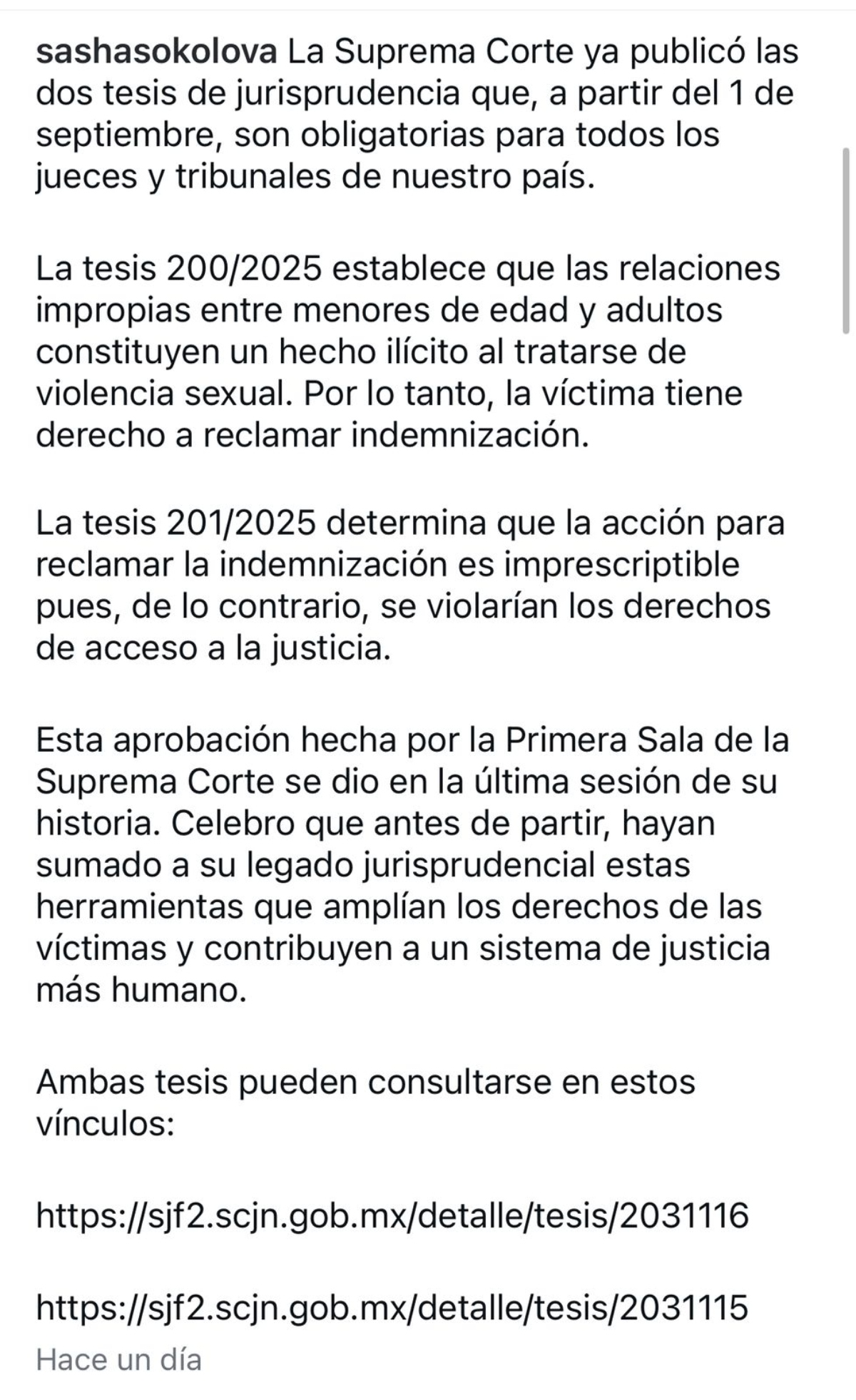
Although criminal prosecution was no longer possible, the Court considered that applying the statute of limitations in this context would violate the victims’ right to access to justice, as well as their rights to personal integrity and fair compensation.
The SCJN ruled that the civil action is imprescriptible in cases of child sexual violence, creating jurisprudence of mandatory compliance in all Mexican courts.
What does this ruling imply for the victims?
Access to justice without delay
It is recognized that the time a person needs to prosecute an assault can be lengthy; preventing the filing of lawsuits for legal time limits can revictimize. Therefore, the Court overruled any statute of limitations on civil claims.
Civil action as a real means of redress
Although the criminal route is closed, victims may still seek redress through civil suits for moral damages, a tool now fully valid and without time restriction.
Immediate and national effects
As of June 25, 2025, all judges and courts in the country are obliged to apply this criterion in similar cases, without exception.

This ruling represents a fundamental victory for the protection of rights, especially in contexts where victims – for cultural, social or emotional reasons – may take years to come forward. For the Hispanic community in the U.S., whether because of family ties to Mexico or cultural empathy, this precedent symbolizes an advance in judicial recognition of delicate and prolonged realities.
Moreover, it demonstrates how justice systems can adapt to deeper understandings of the emotional psychology of victims-something that will strengthen future deliberations and legal reforms in other countries with similar dynamics.
Luis de Llano case did not only conclude with a civil conviction: it became a legal landmark.
The SCJN established that crimes of sexual violence against minors are not subject to the statute of limitations in civil proceedings, reaffirming the rights of victims to justice, reparation and recognition, without time limits.
This legal criterion transcends borders and is a clear sign of progress in the protection of human rights.
Find out more at ‘QueOnnda.com’.