





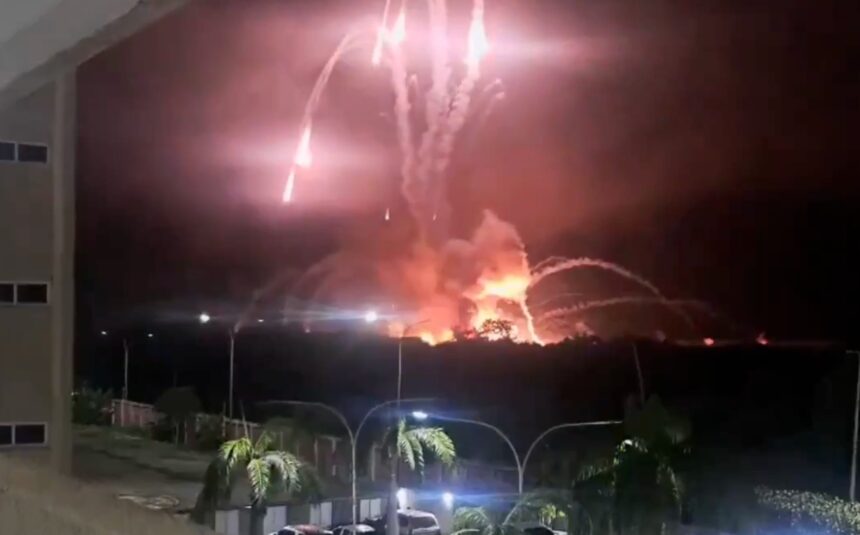
The U.S. Air Force, in coordination with the Federal Aviation Administration (FAA), issued an official notice on Saturday prohibiting U.S. aircraft from operating in Venezuelan airspace, in response to security risks associated with ongoing military activity. The measure comes in the context of reported attacks in Caracas and a diplomatic and military escalation between Washington and the government of Venezuelan President Nicolás Maduro.
The aeronautical notice, known as a NOTAM, went into effect at 2:00 a.m. (Venezuelan local time) and establishes a ban on flights at any altitude over Venezuelan territory for U.S. commercial aircraft. The restriction is initially in effect for 23 hours, although this type of provision may be extended or renewed if conditions persist that pose a risk to civil aviation.
US bans air operations in Venezuela
‼️ 🇺🇸💥🇻🇪 BREAKING: Initial reports indicate that the US Marine Corps has launched an amphibious assault operation north of Caracas. Further details are still emerging. pic.twitter.com/FfHcW2t4O2
– Defense Intelligence (@DI313_) January 3, 2026
In the document, the FAA argues risks to flight safety arising from active military operations, without detailing which forces are involved or the specific nature of the actions.
This language is common in safety NOTAMs, whose main objective is to prevent incidents in areas where the situation can change rapidly and affect civilian aircraft.
Similar measures have been applied in other international conflicts when there is possible interference with navigation systems, presence of missiles or anti-aircraft artillery, or uncoordinated air operations.
For airlines, this means route diversions, possible delays and additional costs, although the priority is the safety of passengers and crews.
Reports of attacks and official versions
Port of La Guaira pic.twitter.com/l0eNdjFE0F
– Zair Mundaray (@MundarayZair) January 3, 2026
The decision coincides with reports of detonations and explosions in Caracas during the early hours of the morning, as well as CBS News reports that U.S. President Donald Trump has ordered airstrikes inside Venezuelan territory, citing officials on condition of anonymity due to national security concerns.
So far, no detailed official Pentagon report has been released on the targets, scope or results of these operations.
For its part, the Venezuelan government denounced a “military aggression” and announced a state of external commotion after what happened in Caracas and in nearby states such as Miranda, Aragua and La Guaira.
Impact for the U.S. Hispanic community.
From the clouds, it rains fire on Maduro’s
narco-criminal Regime. pic.twitter.com/PxFNH3WXpV– VN News (@NoticiaVN) January 3, 2026
For Hispanics living in the United States, especially those who travel frequently, work in aviation, or have family and business ties to Venezuela, the measure is relevant for several reasons:
Flights and connections: Although the U.S. does not maintain regular direct commercial flights with Venezuela, international routes crossing its airspace will need to be rerouted.
Regional security: The closure reflects an elevated level of risk, which can impact aviation insurance, logistics costs and travel times.
Migration and economic context: A sustained escalation may impact migration policies, sanctions and energy markets, issues of interest to Venezuelan and Latino communities in general.
What’s next
🔴 #URGENT | Chaos in Caracas due to bombings over Venezuela. Residents leave their homes in the early hours of the morning and follow the news as they fear more attacks on the capital. pic.twitter.com/TUUqyjNKUb
– World in Conflict 🌎 (@MundoEConflicto) January 3, 2026
The aeronautical authorities usually review these notices on an ongoing basis.
If military activity decreases or the security outlook becomes clearer, the FAA could lift or modify the restriction.
In the meantime, airlines and operators will follow diversion protocols and constant monitoring.
In a scenario still unfolding, the closure of U.S. airspace over Venezuela underscores the gravity of the moment and the priority of protecting civil aviation in the midst of high tension between the two countries.
Filed under: US bans air operations Venezuela