




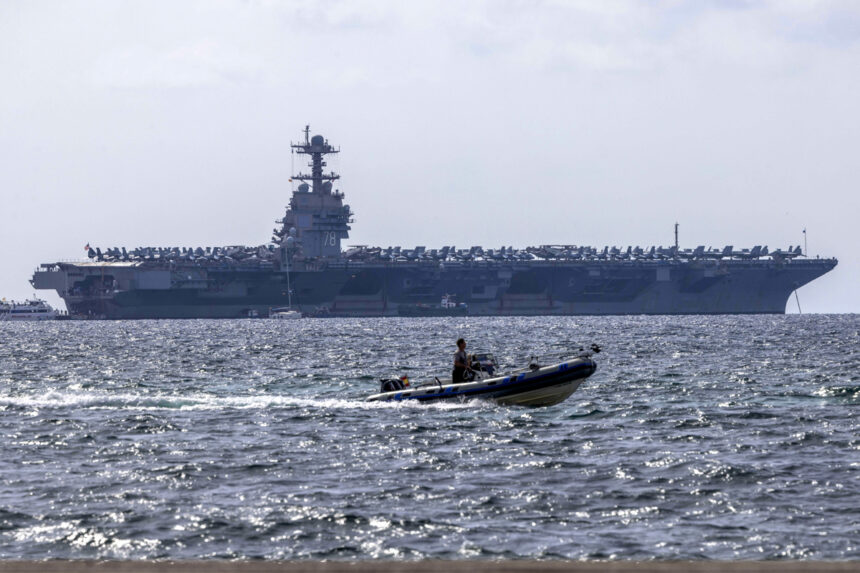
The U.S. Department of Defense announced Friday the deployment of the aircraft carrier USS Gerald R. Ford, the largest and most advanced of the U.S. fleet, to the Caribbean Sea.
The move is part of an intensification of military operations against drug trafficking in the region, just as diplomatic and military tensions with Venezuela escalate.
U.S. deploys aircraft carrier in the Caribbean Sea
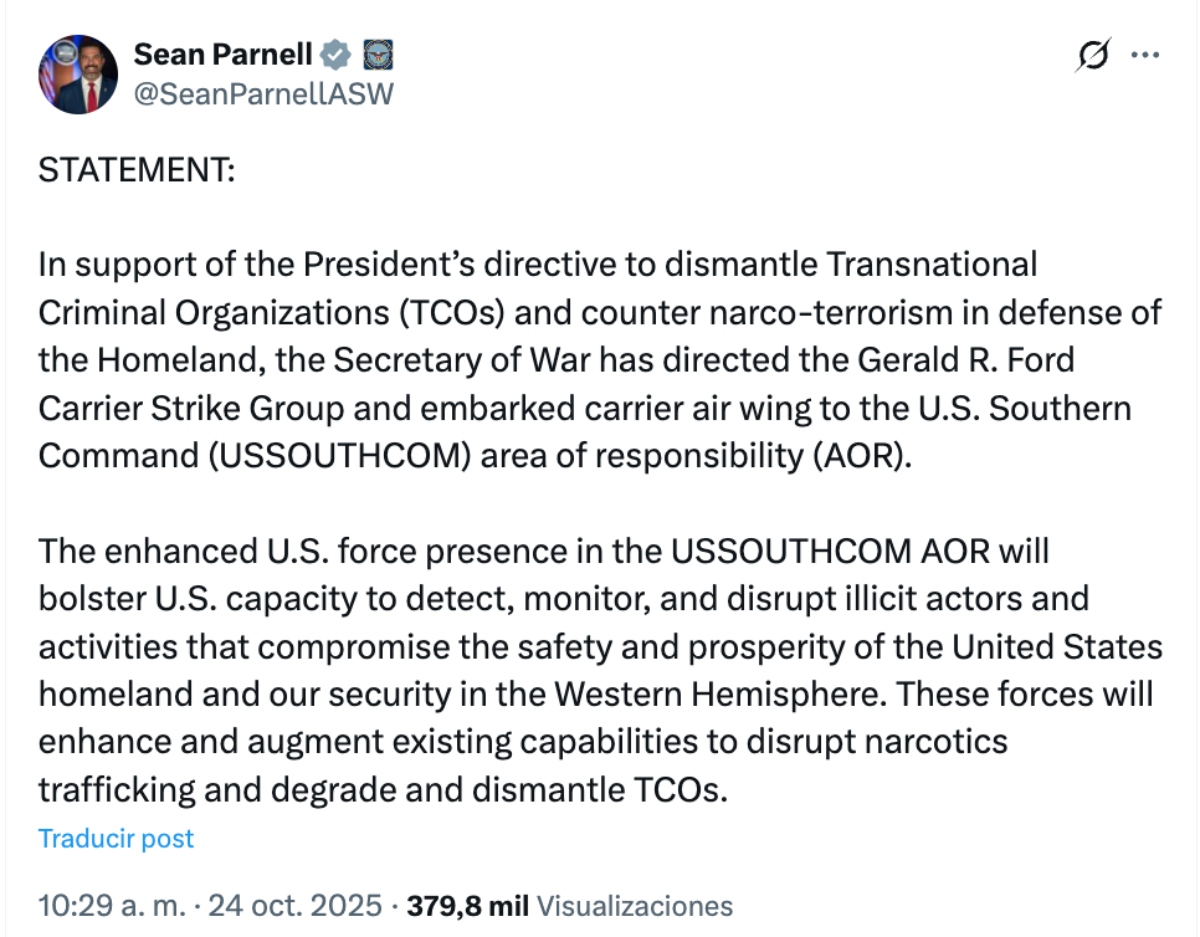
The announcement was made by Secretary of Defense Pete Hegseth, who assured that the deployment responds to a directive from President Donald Trump, focused on “dismantling transnational criminal organizations that threaten the security of the American people.”
According to Pentagon spokesman Sean Parnell, the mission will be under the command of the U.S. Southern Command, which oversees operations in Latin America and the Caribbean.
“The goal is clear: to strengthen our ability to detect, monitor and neutralize illegal activities that threaten regional stability and the security of our borders,” Parnell said.
He also assured that the aircraft carrier and its strike group will significantly expand U.S. military capabilities to confront drug trafficking, illegal maritime routes and other transnational threats.
Largest in the U.S.
This is the USS Gerald R. Ford, the world’s largest aircraft carrier, deployed by the U.S. in the Caribbean.
Images from 2024, during military exercises in the Atlantic. pic.twitter.com/c7fniWPRAe
– Gabriel Bastidas (@Gbastidas) October 24, 2025
The aircraft carrier USS Gerald R. Ford, valued at more than $13 billion, represents the spearhead of U.S. naval power.
It has a crew of more than 4,500, can transport more than 75 aircraft, including F-35B fighters, and has state-of-the-art technology in combat systems, radars and electromagnetic catapults.
This deployment is in addition to the military contingent already active in the region since mid-year, which includes three amphibious assault ships, P-8 Poseidon maritime patrol aircraft, MQ-9 Reaper drones and special units operating from bases in Puerto Rico.
In recent weeks, these forces have intensified their operations, destroying at least ten vessels allegedly used by drug traffickers in Caribbean and eastern Pacific waters.
U.S. confirms new attack in the Caribbean
Overnight, at the direction of President Trump, the Department of War carried out a lethal kinetic strike on a vessel operated by Tren de Aragua (TdA), a Designated Terrorist Organization (DTO), trafficking narcotics in the Caribbean Sea.
The vessel was known by our… pic.twitter.com/lVlw0FLBv4
– Secretary of War Pete Hegseth (@SecWar) October 24, 2025
One of the most recent incidents occurred just this Friday, when Secretary Hegseth confirmed that a boat allegedly operated by members of the transnational criminal group Tren de Aragua sank in the Caribbean.
According to the Pentagon, six people were killed in the attack and were described as “narco-terrorists”.
The military escalation has also generated strong tensions with Venezuela.
The government of Nicolás Maduro has accused the U.S. of violating its sovereignty and of planning a direct intervention under the pretext of combating drug trafficking.
According to Venezuelan media, the U.S. military presence has been interpreted as a veiled threat, especially after it was confirmed that the CIA has initiated covert operations inside the South American country.
The situation is being closely watched by the international community and especially by the Venezuelan diaspora in the US, which is concerned about the escalation of the confrontation.
The Trump Administration insists that its approach seeks to cut off drug trafficking routes before they reach U.S. territory, a strategy that combines military action with cooperation with allied governments.
However, human rights organizations have denounced possible violations of international law, including extrajudicial executions and excessive use of force in international waters.
Filed under: U.S. deploys aircraft carrier in the Caribbean Sea.