





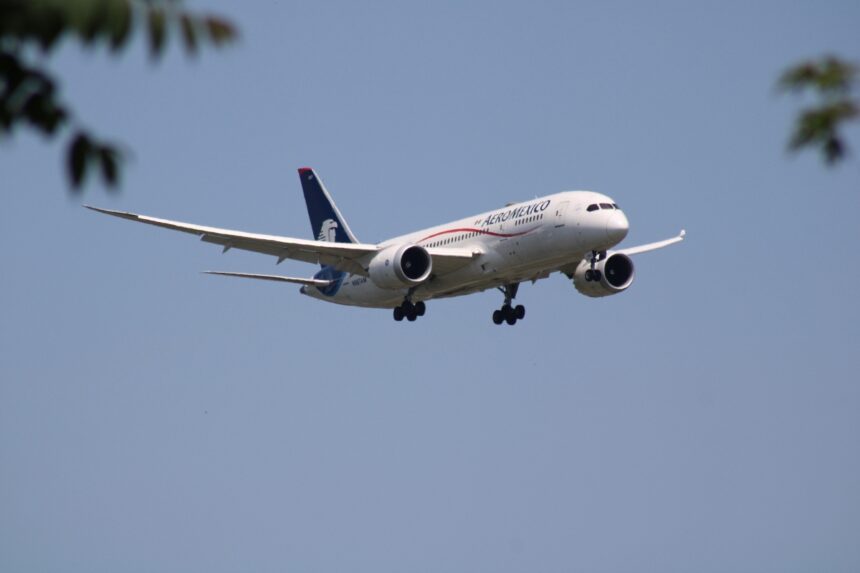
The U.S. Federal Aviation Administration (FAA) on Friday issued five advisories warning U.S. air operators of a “potentially dangerous situation” in airspaces over the Pacific, ranging from Mexico to Ecuador through Colombia and Central America, “due to military activities” and possible interference with navigation systems.
The notices, which will be in effect for 60 days (until March) advise companies and pilots to exercise extreme caution “when operating in the maritime zones over the Pacific Ocean” in the Gulf of California flight information regions in Mexico (MMFR), Central America (MHTG), Panama (MPZL), Bogota (SKED) and Guayaquil (SEFG).
Danger in airspace
The briefs explain that “due to military activities and GNSS (global navigation satellite system) interference, there are potential risks to aircraft at all altitudes, including overflight and the arrival and departure phases of flight.”
The FAA warning appears to point to the possibility of U.S. military aircraft operating without prior notification or with their transponders disabled in these two flight information regions.
The U.S. maintains a naval contingent deployed in the Caribbean as part of Operation Southern Lance, through which Washington has also summarily destroyed suspected drug trafficking boats sailing in the eastern Pacific not far from the Colombian coast.
This same contingent supported Operation Absolute Resolution, by means of which the U.S. Army captured the then Venezuelan president, Nicolás Maduro, in Caracas on January 3.
Mexico rules out any effects
The Mexican Government affirmed that the alert issued by the U.S. Federal Aviation Administration (FAA) regarding a “potentially dangerous situation” in Pacific airspace, including Mexican airspace, is only preventive and does not imply any restrictions or operational effects for national airlines or operators.
In a statement, the Ministry of Infrastructure, Communications and Transportation (SICT), said that the measure announced Friday afternoon by the FAA is only “preventive” which is aimed at strengthening “the attention and care in the air operation within certain regions of the airspace.
In this regard, he explained that there are “no operational implications or restrictions for Mexico, nor for Mexican airlines or operators”.
The SICT stated that the notice was issued “exclusively” to U.S. civilian operators, including their airlines and pilots, “as the authority is only competent to issue regulations applicable to U.S. operators.
He insisted that the communication measure is preventive and is similar to others that were decreed weeks before for the Caribbean region and that there is no “impact on civil aviation in Mexico, nor changes in the operating conditions of the national airspace,” he said.
He added that he maintains permanent communication with international aeronautical authorities to follow up on this type of warnings, “within the framework of cooperation and operational safety”.
The FAA’s warning appears to point to the possibility of U.S. military aircraft operating without prior notification, or with their transponders disabled in these two flight information regions.
The U.S. maintains a naval contingent deployed in the Caribbean as part of Operation Southern Lance, through which Washington has also summarily destroyed suspected drug trafficking boats sailing in the eastern Pacific not far from the Colombian coast.
This same contingent supported Operation Absolute Resolution, by means of which the U.S. Army captured the then Venezuelan president, Nicolás Maduro, in Caracas on January 3.
With information from EFE