




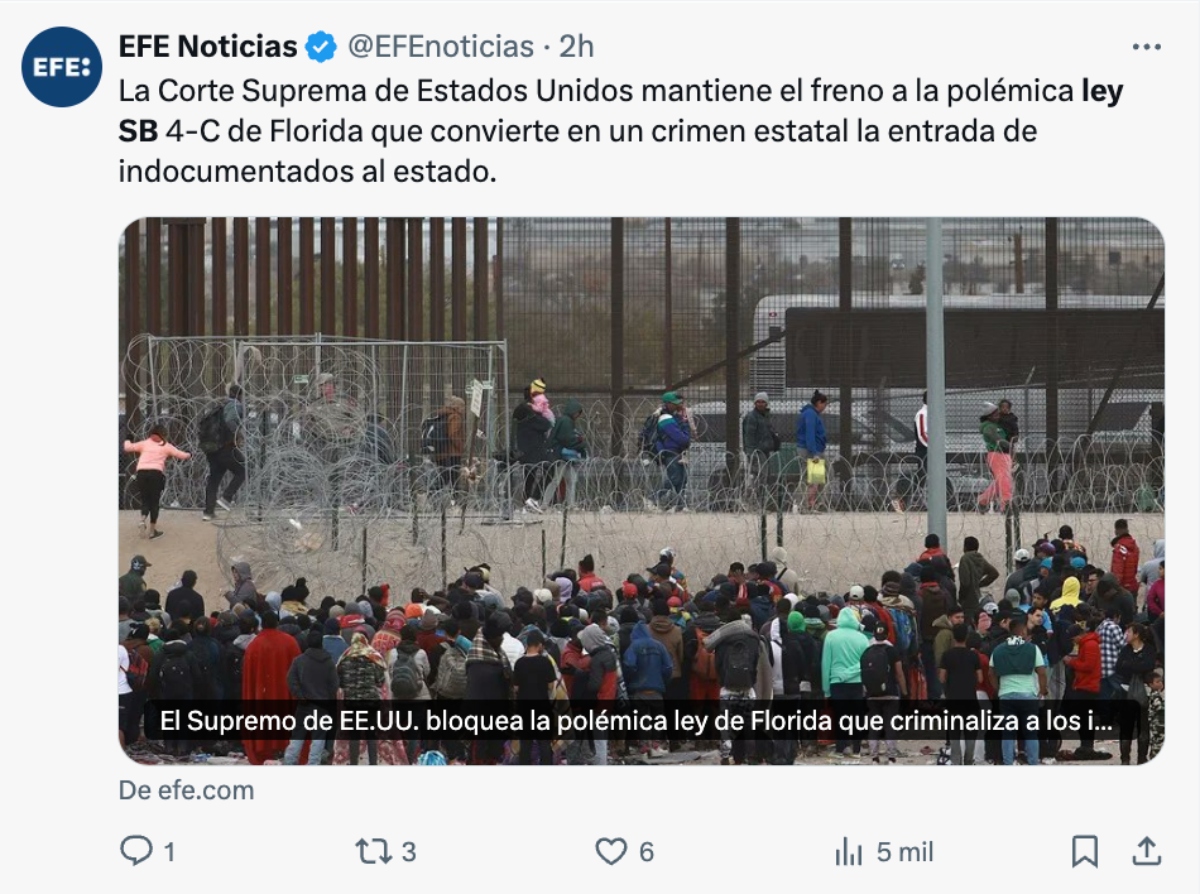
The U.S. Supreme Court decided on Wednesday, July 9, not to lift the temporary block against Florida’s SB 4-C law, one of the harshest state laws against undocumented immigration in the country. The law, promoted by Republican Governor Ron DeSantis, makes it a state crime for undocumented people to enter Florida, even if they come from other states.
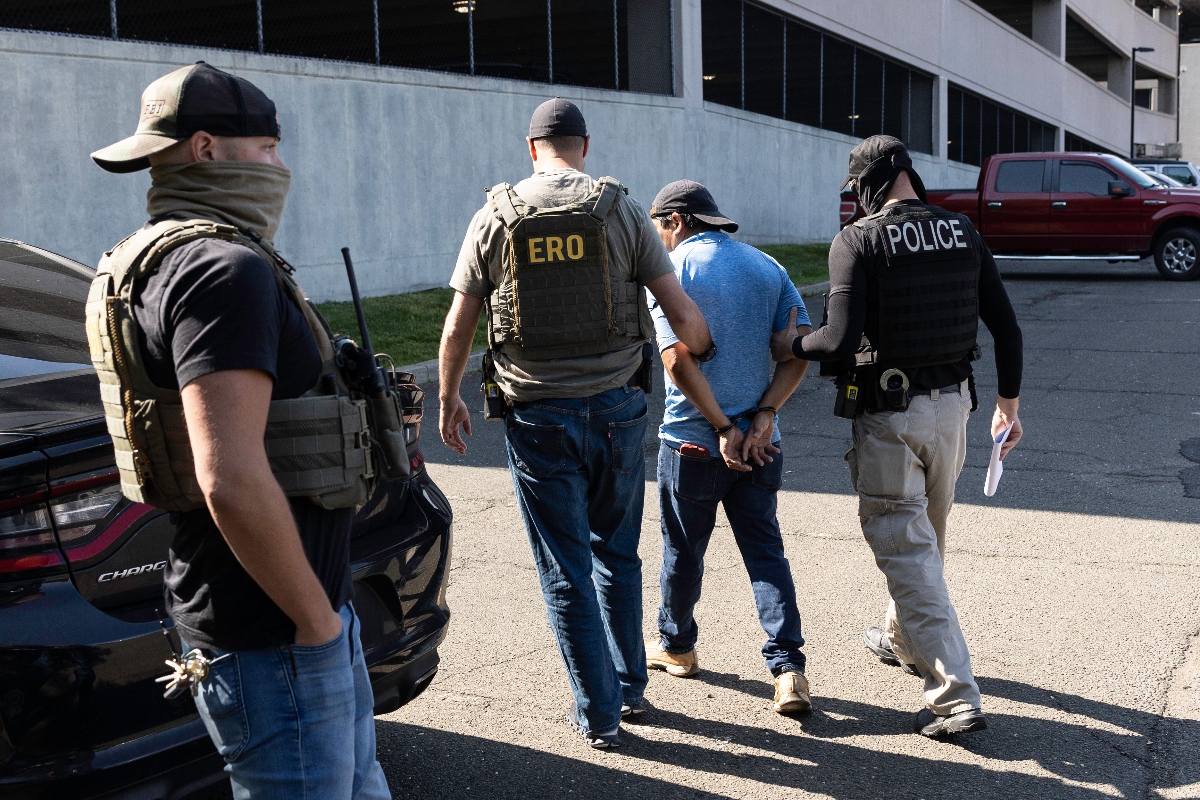
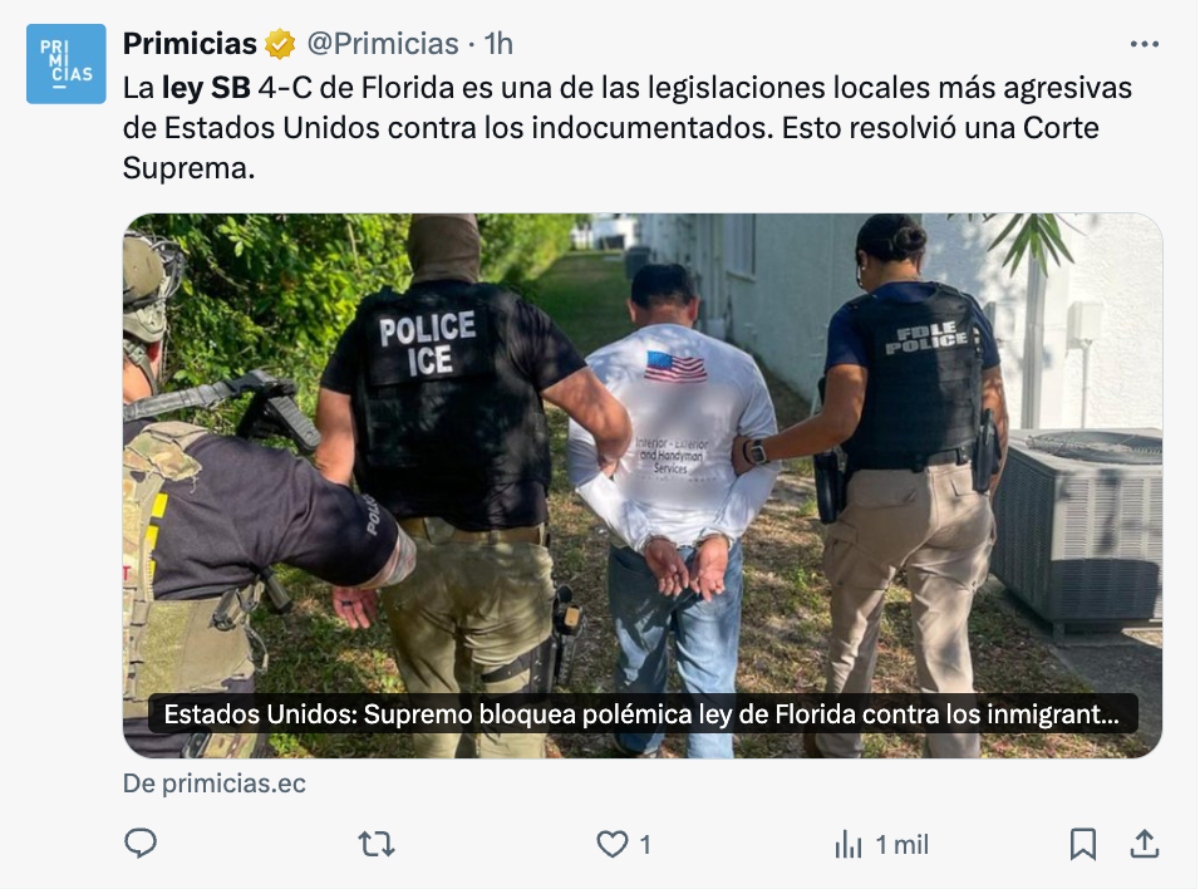
This law would allow state authorities to detain and imprison individuals for the simple fact of having entered the country without authorization, even if their immigration status has since been regularized or they do not have a criminal record. In addition, SB 4-C provides for such individuals to be held in mandatory pretrial detention, without evaluating their individual circumstances.
Florida prosecutor’s motion denied
In a brief decision without comment, the high federal court rejected the request of Florida Attorney General James Uthmeier, who sought to overturn a lower federal court’s order that keeps SB 4-C’s implementation on hold.
The request was filed after Judge Kathleen M. Williams, of the Southern District Court of Florida, held the prosecutor in contempt for ignoring her April 18 order freezing the law from taking effect.
In her original ruling, Judge Williams stated that the legislation was “probably unconstitutional” for encroaching on exclusive federal immigration powers.
Therefore, it issued a preliminary injunction to temporarily halt its implementation while the litigation continues.
Class action lawsuit and legal arguments
SB 4-C was passed by the state legislature and signed by DeSantis in February 2025.
The regulation has generated a strong reaction among organizations defending migrants’ rights.
Immediately, the Florida Immigrant Coalition (FLIC), the Florida Farmworkers Association (FWAF) and several affected individuals filed a lawsuit against the state.
This is on the grounds that the law violates the U.S. Constitution, as only the federal government has the authority to enforce and regulate immigration policy.
In addition to criminalizing unauthorized crossers, the law also requires local authorities to actively cooperate with Immigration and Customs Enforcement (ICE).
This broadens the scope of arrests without necessarily involving federal prosecutions.
National implications
Although the Supreme Court has not yet issued a final decision on the merits of the case, its refusal to intervene for now allows the blocking of this legislation to continue.
This has repercussions beyond Florida, as other states led by Republican governors have shown interest in replicating similar laws, arguing that the federal government has failed to secure the border and control irregular immigration.
The Supreme Court’s decision will be crucial in defining the extent to which states can intervene in immigration issues, which directly affect millions of people living in or transiting through these territories.
Florida, epicenter of immigration tension
Florida is home to more than 5 million foreign-born people, representing approximately one-fifth of its population.
Despite this diverse profile, the state has been one of the most active in implementing restrictive immigration policies.
Ron DeSantis has solidified his conservative agenda by passing legislation that strengthens collaboration with ICE and limits undocumented immigrants’ access to basic services and protections.
This new legal chapter adds to an already tense context for the immigrant community, which faces increasing legal and social risks in several states of the country.
SB 4C would allow state authorities to detain and imprison individuals for the simple fact of having entered the country without authorization