





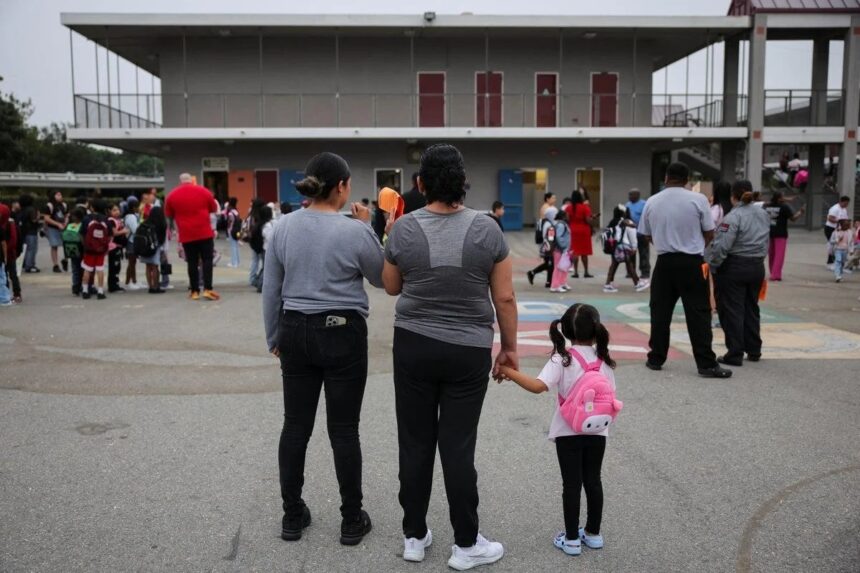
President Donald Trump eliminated federal guidance from the Department of Education that since 2015 guided schools on how to comply with civil rights laws and court rulings mandating services for students who do not know English.
This decision has generated alarm among educators, families and civil rights advocates, as it directly impacts millions of Latino and other migrant students in the United States.
Non-English proficient students and the protection of the law
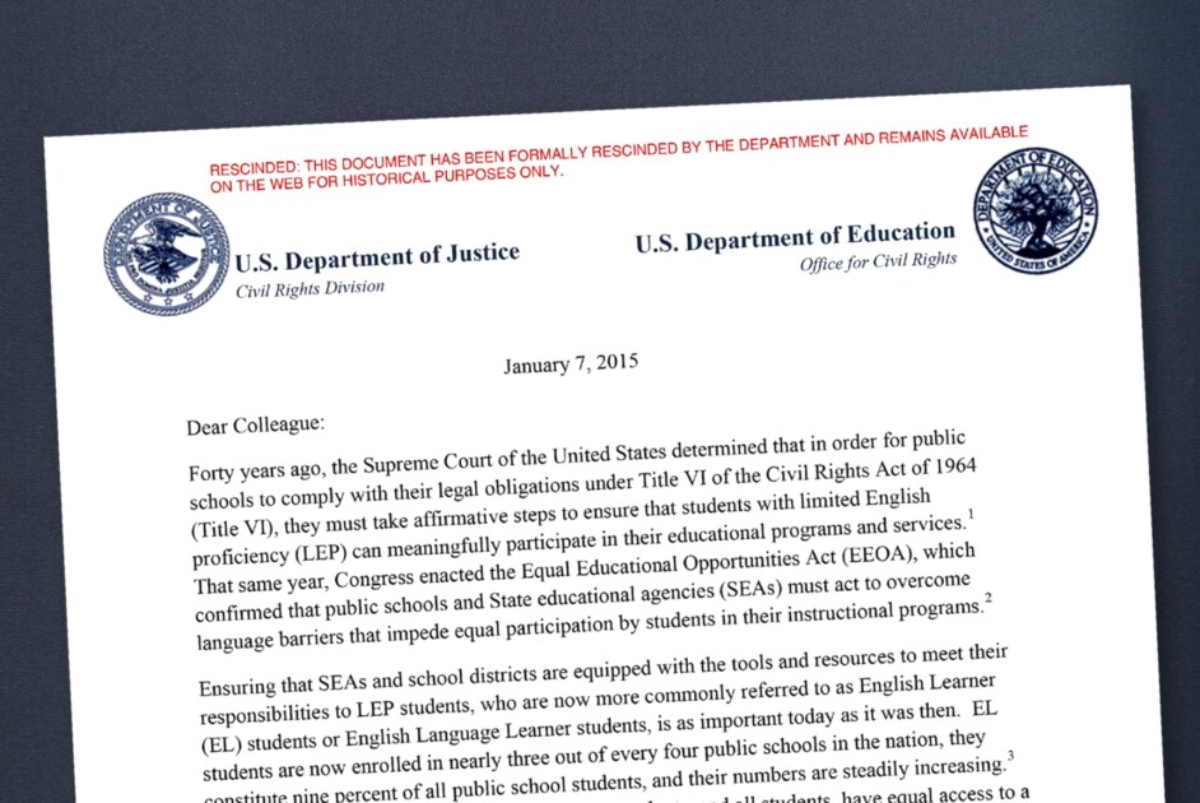
The withdrawn guidance explained how schools must comply with provisions such as Title VI of the Civil Rights Act, which prohibits discrimination based on national origin. For decades, the courts have interpreted that standard as mandating educational support for students who do not know English, thus ensuring equal access to education.
With this elimination, school districts could have more freedom to reduce or even withdraw support programs without fear of federal sanctions. Education experts warn that this opens the door to deeper inequities and infringement of fundamental rights.
Trump’s new English language policy

In February, Trump signed an executive order designating English as the official language of the United States and eliminated the mandate requiring federally funded agencies and institutions to offer services in other languages.
At the same time, the Department of Education laid off most of the staff of the Office of English Language Acquisition, weakening the structure in charge of supporting those who have not yet mastered the language.
In mid-year, the Department of Justice sent a memo to all federal agencies urging them to “minimize non-essential multilingual services.”
According to the administration, prioritizing English seeks to “promote assimilation rather than division.”
However, critics point out that these measures actually hinder the learning and integration of students who do not know English.
Impact on non-English proficient students and their families
The Trump administration also temporarily withheld $890 million earmarked for English language learning and proposed its elimination in the next federal budget.
Education advocates believe that this decision contradicts the stated goal of language proficiency for all students.
Jeff Hutcheson, director of public policy for TESOL International, explained that the situation places students in a paradox:
“We want them to learn English, but at the same time we reduce the resources that make that learning possible.”
In practice, this affects primarily Latino communities and other migrant groups that depend on these programs to provide their children with equal opportunities in the educational system.
Educators also warn that, without these supports, it will be more difficult for students to achieve academic and social integration.
A debate that transcends education
President Trump’s “mandatory English” policy is not limited to the school setting.
Other government agencies have also reduced services in Spanish and other languages.
One example is the Department of Housing and Urban Development, which recently eliminated its Spanish page under the slogan “HUD is English only.
For civil rights advocates, these measures represent a setback to equal access to education, health and public services for millions of people who do not know English.
The debate centers on whether the priority of English as the national language should be imposed by reducing supports that have historically facilitated the integration of immigrant communities.
This article was originally published in Nueva News.