



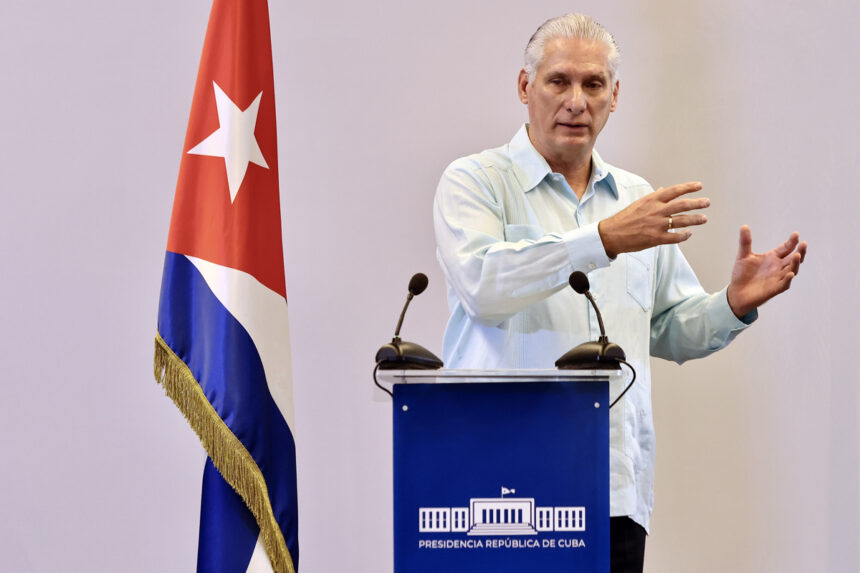
Official silence is broken at the most critical moment. President Miguel Díaz-Canel confirmed this Friday that the dialogue between Cuba and the U.S. is already underway, although in initial stages and with no agreements in sight.
Under the pressure of an oil blockade that has the island on the verge of energy collapse, Havana is seeking a diplomatic solution in ‘discreet’ talks that involve even Raul Castro’s closest entourage.
Initial Phases: What Cuba seeks at the table with Washington
🇺🇸🇨🇺 The historic moment when Cuba’s dictator, Miguel Díaz Canel, announces on national television that they have given in to pressure and are officially in negotiations with the United States.
The Cuban regime completely surrendered, on the verge of death.pic.twitter.com/lDAjV4cwh9
– Agustín Antonetti (@agusantonetti) March 13, 2026
Cuban President Miguel Díaz-Canel acknowledged this Friday a “dialogue” with the US, as Washington had been claiming for weeks, but indicated that it is in “initial stages” and that they are “far away” from any agreement.
The announcement is a watershed in the escalation of tensions between the two countries following the beginning of the US oil blockade of Cuba, a measure that has brought the island, which was already in a serious economic, energy and social crisis, to the brink of collapse.
“Cuban officials recently held talks with representatives of the U.S. government to seek through dialogue a possible solution to the bilateral differences that exist,” the president said shortly after the news was announced in a communiqué issued by the Communist Party of Cuba (PCC, the only legal party).
The objective, he added, is to “determine which bilateral problems need to be solved”, to see “which would be the ways to solve those problems” and, finally, “to determine if there is the will to carry out actions on both sides for the benefit of our peoples”.
He indicated that these conversations imply a “fundamental effort to be able to advance in solutions”, as well as the “construction of spaces of understanding” and “areas of cooperation” that allow both countries to “advance in understanding and move away from confrontation”.
“This is a very sensitive process that is approached with the discretion that it takes at every moment, also with sensitivity, with responsibility and with great seriousness,” he stressed.
Díaz-Canel did not detail what topics the agenda of this dialogue might contain nor the possible points of friction which, in any negotiation, would imply compromises and concessions on both sides.
Sovereignty and respect: Diaz-Canel’s non-negotiable conditions
🇨🇺🇺🇸| END OF COMMUNISM.
Cuban dictator Miguel Diaz Canel announces that he has authorized the FBI to enter the country. pic.twitter.com/ER9pydK2P3
– VIKING (@WalhallaMann) March 13, 2026
The president added that in these “exchanges”, the Cuban side has expressed “the will” that the talks be held “on the basis of equality and respect for the political systems of both states, for the sovereignty and self-determination” of both governments.
Díaz-Canel thanked the “international actors” who “favored” these contacts, although he did not expressly mention any of them.
The Mexican government had offered on several occasions to mediate and on Thursday it was reported that talks with the Vatican had led Havana to decide to release 51 prisoners.
In this regard, the NGO Prisoners Defenders said on Friday that it is aware of at least five releases in the last few hours.
According to its records at the end of February, Cuba held a total of 1,214 political prisoners.
The Raúl Castro factor: The role of the grandson “El Cangrejo” in the negotiations
🔴 CUBA 🇨🇺 | Dictator Díaz-Canel appears in meeting with Raúl Castro’s grandson, ¨El Cangrejo¨ and confirms negotiations with #US government 🇺🇸.
This unprecedented event, which hopefully will lead to a radical change in the Cuban regime that for more than 67 years has subjected the… pic.twitter.com/L7hD8mTFs3
– JOURNAL SupreMo 🔴 (@Diario_Supremo) March 13, 2026
The president assured that the decision to initiate these contacts with the US was taken “in a collegiate manner” between former president Raúl Castro – who is the country’s great political reference despite not holding formal positions -, himself and members of the Government, the State and the Communist Party of Cuba (PCC, the only legal party).
Significantly, the announcement was attended by Raul Guillermo Rodriguez Castro, Raul Castro’s grandson without relevant institutional positions but who several media have pointed out in recent weeks as the leader of the Cuban side in the first contacts with the US.
Rodriguez, responsible for his grandfather’s personal security and apparently very close to the former president, has not participated until Friday in political events of this type and his role was limited to accompanying the former president, in a discreet background, in his little public activity.
Diaz-Canel also explained in his appearance that Cuban authorities are expecting a visit from agents of the U.S. Federal Bureau of Investigation (FBI) to collaborate in the clarification of the incident of the boat from the U.S. in which five people died.
This event, which occurred on February 25, and which Cuba described as “infiltration for terrorist purposes”, could become another source of political tension in the escalation between Havana and Washington.
In recent months, the United States has qualitatively increased pressure on Cuba by blocking the entry of oil imports to the island, which only produces a third of the crude oil it needs to meet its energy needs.
U.S. President Donald Trump had assured on several occasions in recent weeks that representatives of his Executive were maintaining contacts with Cuban authorities and urged Havana to close a deal before it was too late.
The Cuban government denied these talks on several occasions, but stopped doing so in recent weeks.
Filed under: Cuba in dialogue with USA
With information from EFE