




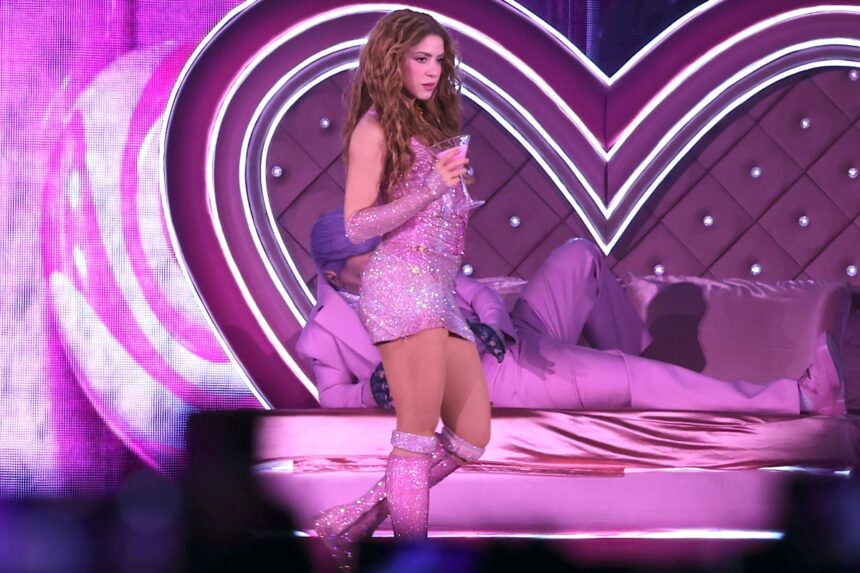
Colombian singer Shakira Shakira decided to open one of the most intimate pages of her recent life through a letter entitled “Crying is no longer enough”. The text, published by the newspaper O Globo and picked up by El PaísThe text, published by the newspaper O Globo and reprinted by El País, crudely exposes the emotional process he went through in 2022, a year that marked a before and after in his personal history.
This reflection comes at a key moment, prior to his long-awaited presentation at the iconic Copacabana Beach. Copacabana BeachCopacabana Beach, where a massive attendance of over two million people is expected.
Shakira talks about being a single mom: an unexpected personal break

In her letter, Shakira describes how her life changed abruptly after the end of her relationship with Gerard Piquéwith whom she shared more than a decade. This episode was compounded by the delicate state of her father’s health, which intensified the emotional impact.
“It was a morning in which I woke up as another woman,” she says, making it clear that there were no previous signs that anticipated the magnitude of the change. The artist emphasizes that the process did not allow her to stop, since she had to continue with her responsibilities as a mother and professional practically immediately.
This experience, far from paralyzing her, forced her to adapt to a new reality in which she had to assume multiple roles with no room for pause.
From this period of transformation was born Women Don’t Cry Anymorea project that, according to the singer herself, does not seek to feed resentment or victimization. On the contrary, she defines it as a mature reflection on resilience.
“I had to completely reinvent myself,” she says, noting that her evolution encompassed all aspects of her life: as a mother, as an artist and as a woman. Music, in this sense, became a tool to process pain and turn it into strength.
A look at today’s Latina woman

Beyond her personal experience, Shakira expands her discourse to a collective reflection on the role of Latin women today. In her letter, she argues that traditional stereotypes have been left behind and that today women occupy leadership roles in all areas.
For the artist, her story is not unique, but representative of a generation that has had to get ahead in complex contexts. “My story is the story of many,” she suggests, recognizing that thousands of women face similar challenges while sustaining their homes and life projects.
The free concert in Copacabana will not only be a musical show, but also a tribute to that feminine strength that the singer describes. Shakira has especially highlighted the case of Brazil, where millions of households are headed by women, as an example of this social transformation.
Thus, her presentation is shaping up to be more than just a mass event: it will be a celebration of resilience, independence and leadership, values that the artist has decided to place at the center of her message.