




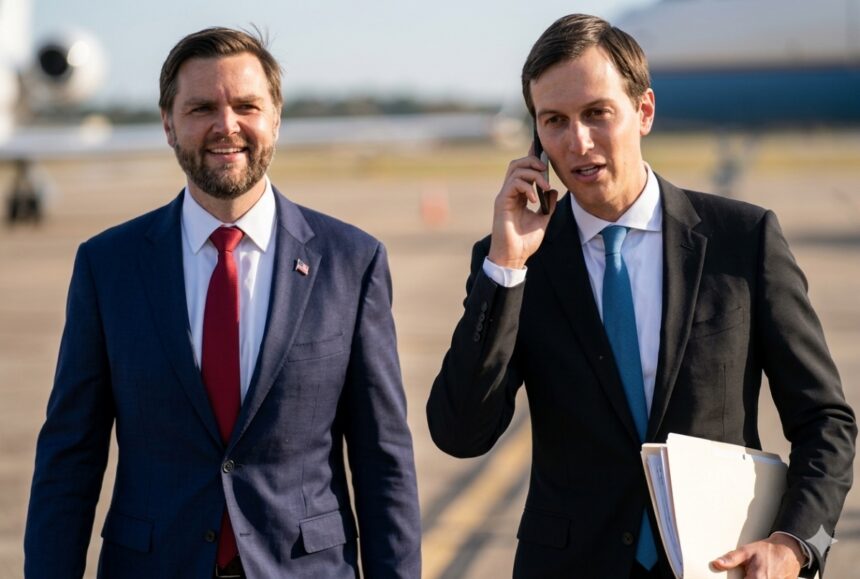
The U.S. delegation, led by JD Vance, and the Iranian delegation are scheduled to sit at the table this Saturday in Islamabad to try to consolidate a roadmap to end the war.
However, the negotiations are starting under deep uncertainty, marked by disagreements and last-minute cross-demands that threaten to collapse the Pakistani mediation. These are the five key negotiation points in Pakistan:
1. Contradictions about the agreed text
🔊PR No.9️⃣9️⃣/2️⃣0️⃣2️⃣6️⃣
Arrival of the US Delegation for Islamabad Talks
🔗⬇️ pic.twitter.com/MO9hkpnpf0– Ministry of Foreign Affairs – Pakistan (@ForeignOfficePk) April 11, 2026
In addition to the military violence and ultimatums, there is a serious diplomatic rift: the parties are defending completely opposite interpretations of the basic document of the agreement, including whether the document is the 10-point document delivered by Iran and announced by Pakistan as the start of negotiations, or the 15-point document that Trump sent to Tehran days ago and that Iran publicly rejected.
According to the demands made by each delegation, Tehran maintains that the text protects Lebanon in the truce and includes recognition of its right to uranium enrichment, two clauses that the United States categorically denies having granted.
Sitting down to negotiate with this difference on the fundamental terms entails a risk of rupture at the first working session.
2. Lebanon’s exclusion from the cease-fire
“We are going to destroy all the houses in the villages on the border line in southern Lebanon.”
Israel Katz, “Israel’s” defense minister, admitted on camera that the aim of the genocidal Zionist army is to destroy all Lebanese families’ border houses…. pic.twitter.com/e4L6mQ3SnM
– Daniel Mayakovski (@DaniMayakovski) April 11, 2026
It is the main point of friction on the ground.
While Islamabad and Tehran claim that the 14-day ceasefire covers Lebanon, Israel maintains its offensive against Hezbollah with hundreds killed, even after President Donald Trump called on Prime Minister Benjamin Netanyahu to scale back operations.
In response, the Speaker of the Iranian Parliament, Mohamad Baqer Qalibaf, raised the protest, warning that the cessation of these attacks is a non-negotiable condition for initiating dialogue.
3. Iranian assets frozen
Arrival of the US Delegation for Islamabad Talks pic.twitter.com/Hai19EZm4I
– Ministry of Foreign Affairs – Pakistan (@ForeignOfficePk) April 11, 2026
Along with the Lebanese front, Tehran has introduced the demand for the release of Iranian funds blocked by the United States as the second precondition accepted for the start of negotiations.
Non-compliance with this disbursement poses a problem even before the general lifting of sanctions included in Tehran’s roadmap can be discussed.
4. The blockade of the Strait of Hormuz
🇮🇷 Iran’s biggest problem at the negotiating table might be one it created itself…
The NYT reports Iran can’t fully reopen Hormuz because it literally cannot find all the mines it planted.
The IRGC used small boats to mine the Strait haphazardly in the early days of the war…. https://t.co/0rw3kxNaGe pic.twitter.com/ArOBEd67K2
– Mario Nawfal (@MarioNawfal) April 11, 2026
Despite the temporary truce agreed on Wednesday, one of the knots of the conflict remains intact, because the Strait of Hormuz has not been reopened to free commercial transit as stated in the ten-point proposal announced by Pakistan.
Iran affirms that it will only open this route, through which 20% of the world’s oil flows and which is its main pressure card, when the bombing of Lebanon ceases. The Iranian proposal also demands to maintain control of this route, in defiance of the demands of Washington and the international community for free navigation.
5. Washington’s counter demand
🚨TRUMP COMMENTS ON NUCLEAR WEAPONS 🚨
TRUMP: “IRAN WILL NEVER GET A NUCLEAR WEAPON. THAT IS 99% OF THE DEAL”.
THE STRAIT OF HORMUZ WILL STAY OPEN. IT IS INTERNATIONAL WATER.
IRAN’S NAVY AND AIR FORCE? EFFECTIVELY DESTROYED.
TRUMP DOES IT DIFFE…Show more pic.twitter.com/DVzroMFr9j
– Money Ape (@TheMoneyApe) April 11, 2026
In the face of the Iranian conditions, the US delegation, led by Vice President JD Vance, has added its own last-minute demand to the agenda.
According to The Washington Post, the U.S. will request the release of at least six U.S. citizens in Iranian custody.
Vance warned before traveling that they will use the meeting to test whether Tehran is willing to negotiate “in good faith,” or whether it is trying to “mislead” the U.S. team.
Filed under: Key negotiation points in Pakistan
With information from EFE