





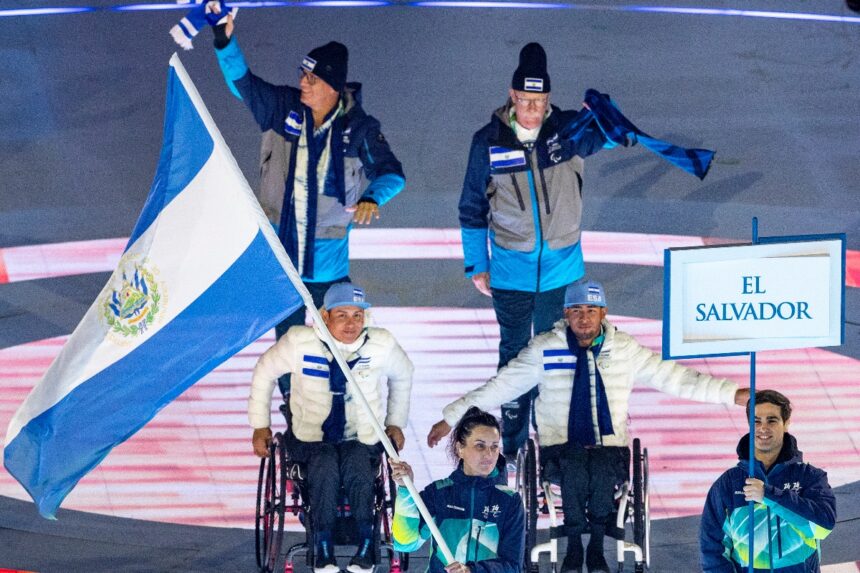
David Chavez and Jonathan Arias live parallel stories. Both are in wheelchairs, both suffer from a disability resulting from a gunshot wound, and both have become in Italy the first athletes from El Salvador to compete in a Paralympic Winter Games in the discipline of cross-country skiing. David Chavez, 27 years old, was born in San Salvador. When he was fourteen years old, he was shot after a robbery perpetrated by gang members. At the same age, Jonathan Arias, 28, also suffered a shootout between rival gangs that left him paralyzed from the waist down and made him see his new life from a wheelchair.
In the headquarters of Tesero, in the Milan Cortina Games, the two Salvadorans became the first athletes in the history of the Central American country to compete in the Paralympic competition. They did so in the sprint kilometer event in cross-country skiing.
From training in sand to the Paralympic Games
View this post on Instagram
David Chavez qualified directly, after being eighteenth in the World Championship in Trondheim (Norway), while Jonathan Arias obtained his qualification after an invitation from the International Paralympic Committee after not obtaining the ticket initially by sport classification.
For both of them, it was the culmination of a dream that began with training in sand and was forged thanks to the help of several American ‘guardian angels’ they came across along the way.
“The story behind these two athletes comes in the wake of gang violence and for that very reason is an inspiration in itself.”
“They have overcome adversity and are now making history,” declares Salvador “Chacha” Salguero, president of the Salvadoran Snow and Ice Federation.
Gang violence
View this post on Instagram
David Chavez’s life changed on January 7, 2015, a date he will never forget.
That day, he was helping his aunt move furniture when Barrio 18 gang members robbed them at gunpoint.
He tried to flee but one of the gang members opened fire and shot him in the spine. He was diagnosed with a spinal cord injury.
After being in the hospital for more than twenty days, the acceptance of the new reality was a long process. I was crying all the time.
He tried to seek refuge in sports and found it.
He began playing on a youth wheelchair basketball team and there he met another boy who had also suffered the consequences of violence. He was Jonathan Arias.
Jonathan had been shot in a gang dispute in La Libertad, a coastal town 35 kilometers from the capital.
It was the time when Barrio 18 and MS-13 were sowing fear in the streets of some parts of the country.
In his case, Arias spent nearly a year in the hospital dealing with his fears and a myriad of negative thoughts that put him through a difficult psychological time.
Jonathan Arias moved to live in El Salvador and signed up for a wheelchair basketball team, which he joined shortly before David Chavez.
An encounter that changed their destiny
View this post on Instagram
David Chavez and Jonathan Arias were playing basketball together until the pandemic dashed any hope of progressing in the sport.
Arias returned to La Libertad and after finishing his confinement, he went to work selling shaved ice to help support his family.
He did it sitting in a wheelchair next to a road where everyone who passed by raised a great dust.
There, in one of those fortuitous events, she met Rob Powers, an American in love with El Salvador, who would change her life once again.
Powers, a Colorado native, was an Army veteran who had coached the U.S. ski team for more than a decade.
Upon retirement, he created a program with former Olympic athletes, war veterans and people who had suffered the setbacks of war to help them transition into their new life reality.
That project crossed borders and in 2010 a friend asked Powers if he would go to El Salvador to collaborate with the Central American country’s Olympic Committee.
His friend was Sean Colgan, a member of the U.S. Olympic rowing team.
After leaving top-level sport, he decided to create a foundation for sports programs focused on scientific research and support for vulnerable groups.
Surfing, the prelude to snow
View this post on Instagram
Powers and Colgan joined forces to create ONETEAM El Salvador to provide support and training to low-income youth.
First they did it through a surfing program, something Arias loved.
Yet he had grown up near the sea.
He signed up and, shortly after starting to train, went to the World Championships in California, where he finished tenth.
During that time, David Chavez and Jonathan Arias’ friendship was maintained.
Chavez, after the pandemic, had retrained as an UBER driver when he received the call from his friend.
“Sign up with me to surf,” he told her.
And the two formed a successful partnership in the water, reaching the top of the world rankings.
Surfing was his new dream, but the blow came when the sport was left out of the Los Angeles 2028 competitive program.
It was then, in another of those twists of fate, that another American, Dan Cnossen, who arrived in El Salvador to surf and became a legend in winter Paralympic sports with medals in cross-country skiing and biathlon, appeared on the scene.
They became friends and, despite being a country with no tradition in snow sports, they were captivated by these new sports that they had discovered through Cnossen.
They started practicing them and soon after they competed in the Continental Cup in Norway in 2023.
The result was as expected. Last and penultimate. Even so, they did not lose faith or desire. On the contrary. They decided to take on this new challenge.
Sign up for surfing with me
Jonathan Arias
Chavez and Arias make history for El Salvador
View this post on Instagram
David Chavez and Jonathan Arias began training at El Cocal Beach in conditions far removed from what a snow sport should be.
On the coarse sand, they established their training base and, based on tenacity and willpower, they managed to progress in their results after competing in Argentina and different countries of central and northern Europe until they reached the Paralympic Games.
“We know we are not going to have a medal but having qualified already makes us part of history.”
“No one is going to erase what we have experienced and I hope that the generations to come will know how to appreciate it”.
Confessed to EFE Chavez, 27th in the qualifying round of the sprint kilometer cross-country skiing with a time of 2:33.69.
His inseparable teammate, Jonathan Arias, was a little further down the rankings. He finished 36th with a time of 2:56.79.
The result is almost the least important thing. The most important thing is the ability to overcome and the illusion for a dream.
“This is a historic moment and we will never forget it.”
“We have represented El Salvador in the best way in the biggest event of Paralympic winter sports.”
“The dream has been fulfilled,” Arias concluded.
With information from EFE
For more information, visit QuéOnnda.com