





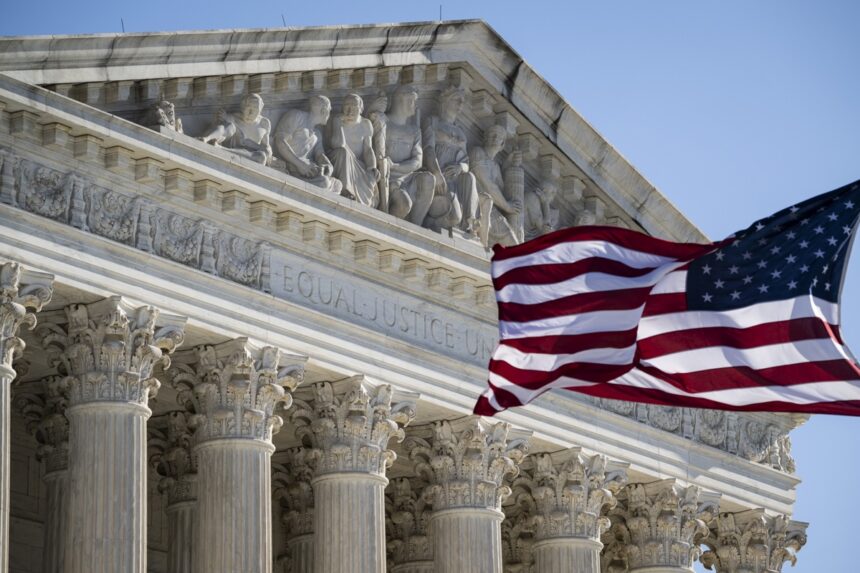
The U.S. Supreme Court issued a ruling rolling back historic protections for racial and ethnic minority voting under the Voting Rights Act (VRA), at a key moment ahead of the November 2026 midterm elections.
The decision has generated strong reactions from civil organizations, especially in the Latino and African-American communities, which warn of a possible setback in the political representation of these groups.
US Supreme Court minority vote
BREAKING: The Supreme Court significantly narrowed a key provision of the Voting Rights Act, further eroding the impact of the landmark civil rights-era law. https://t.co/ACM2c62GIu
– POLITICO (@politico) April 29, 2026
The decision of the highest court annulled an electoral map in Louisiana, considering that its design was excessively based on racial criteria.
In its ruling, the Court argued that the Voting Rights Act did not require the state to create additional districts with a majority of African-American voters, which limits the use of race as a criterion in electoral redistricting.
With this decision, the court reduces the scope of Section 2 of this federal law, a key tool for decades to combat electoral discrimination and guarantee representation to historically marginalized communities.
Impact on Latino and African American voters
The conservative majority limited the obligation to create African-American districts in Louisiana.https://t.co/D5W8iSDA7x
– Excélsior (@Excelsior) April 29, 2026
Several civil rights organizations warned about the possible consequences of the ruling.
Hector Sanchez Barba, president of Mi Familia Vota, said the decision “reverses decades of progress” and could weaken Latino voters’ ability to influence democratic processes.
In the same vein, the group All Voting is Local warned that the ruling will make it more difficult for African-American and other minority communities to achieve fair representation on key issues such as employment, health, housing and safety.
One of the most criticized points is the elimination of restrictions against practices such as gerrymandering, which can dilute the voting power of certain communities.
Political context: redrawing of electoral maps
BREAKING: The Florida House passed Gov. Ron DeSantis’s redistricting map in an 83-28 vote, a plan that could boost GOP House seats in 2026. It now heads to the Florida Senate. pic.twitter.com/io0XXRGnSc
– Breaking911 (@Breaking911) April 29, 2026
The ruling comes in the midst of a national process of electoral redistricting being pushed in several states ahead of the mid-term elections.
Since 2025, President Donald Trump promoted initiatives to redraw districts in Republican-ruled states, starting with Texas and extending to other entities, most recently Florida.
This process, which normally occurs every 10 years after the census, was brought forward in several states, generating an intense political dispute between Republicans and Democrats.
Possible effects on Congress
U.S. Supreme Court rolls back historic voting protections for racial and ethnic minorities in Voting Rights Acthttps://t.co/ieVBy2FCpo
– EFE News (@EFEnoticias) April 29, 2026
Experts warn that the Supreme Court’s decision could directly influence the balance of power in Congress.
By limiting the creation of minority-friendly districts, the ruling could benefit Republican candidates and expand their majority in the House of Representatives by as many as 20 seats.
In response, states governed by Democrats, such as California, have also pushed their own electoral redesigns to counter these changes.
The U.S. Supreme Court’s ruling on minority voting
🗣🗳Several Latino civic associations condemned the ruling issued by the U.S. Supreme Court, which weakened voting protections for racial minorities in the Election Law, and lamented that it may silence voters in the Hispanic community.
🔗https://t.co/kVVHBHYqea– Channel 44 (@CANAL44TV) April 29, 2026
The ruling has reignited the debate over voting access and electoral fairness in the United States.
While conservative sectors argue that the decision reinforces the principle of equality by avoiding the use of race in electoral decisions, civil organizations argue that it ignores historical inequalities and limits key tools to protect vulnerable voters.
With the November 2026 elections on the horizon, this decision could have a significant impact on voter turnout and the representation of Latino and African American communities in the country.
Filed under: US Supreme Court minority vote