



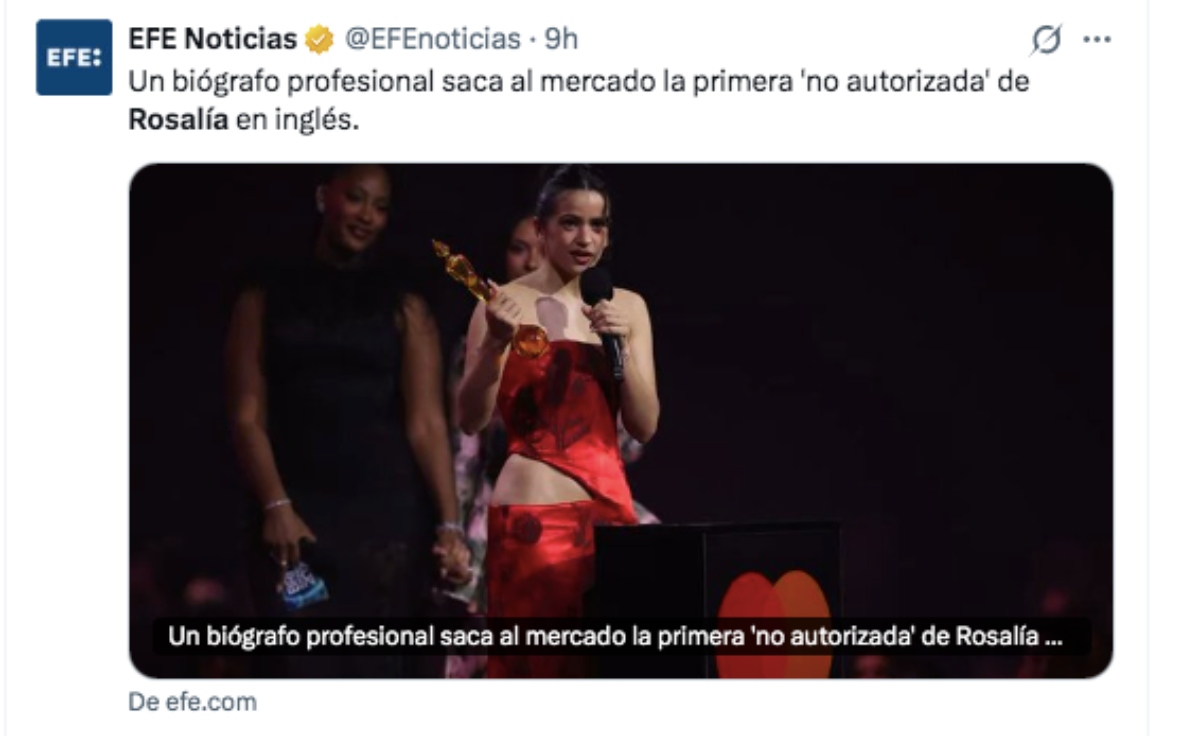
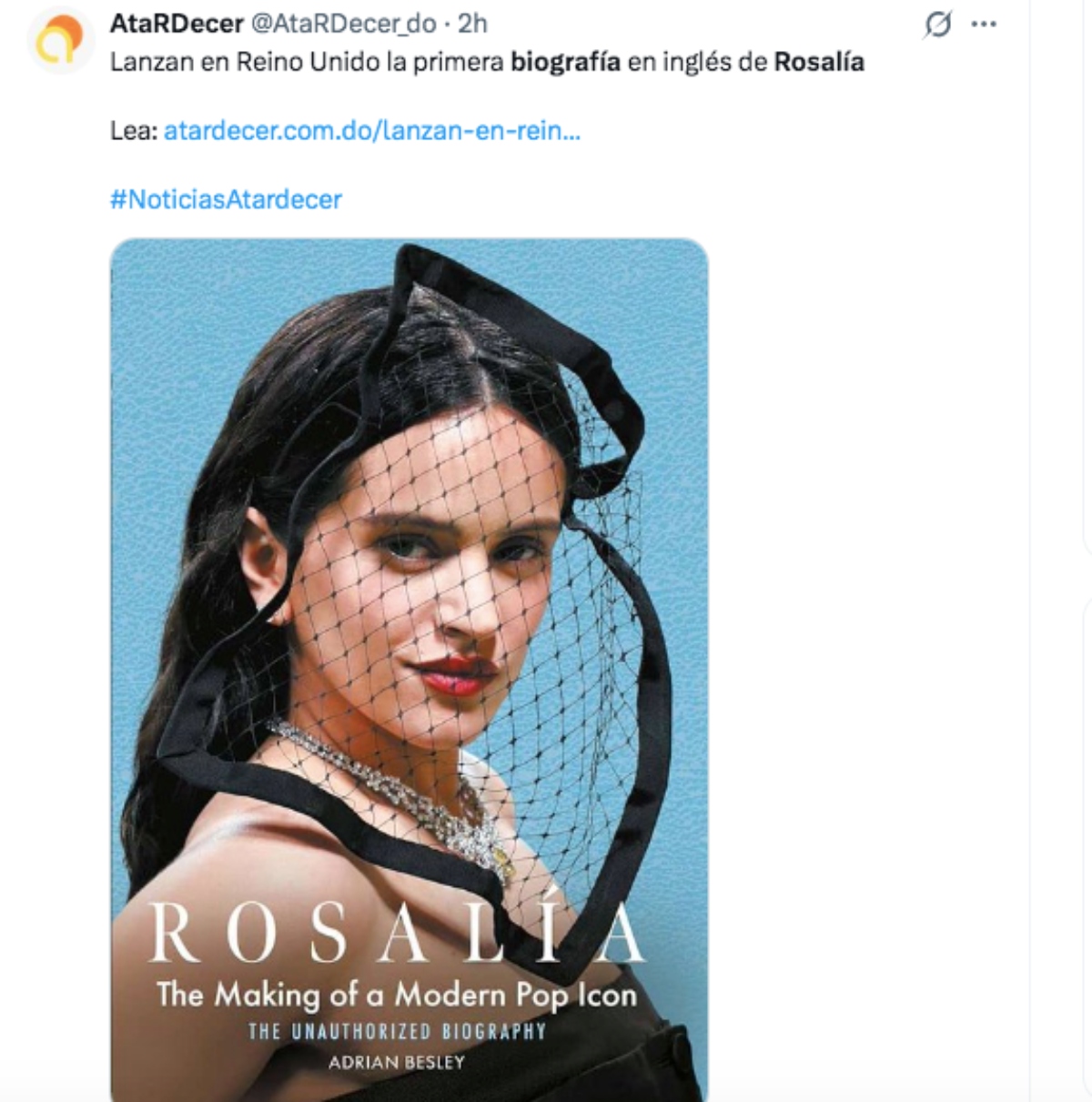
The ‘Rosalía’ phenomenon landed this Thursday in the UK bookstores with the launch of what claims to be the first unauthorized biography in English of the Spanish artist. Its author: Adrian Besley, a kind of professional biographer who has done the same work with Billie Eilish or the k-pop groups BTS and Blackpink.
Entitled ‘Rosalía: the creation of a modern pop icon’ and published by the British publisher Michael O’Mara (not yet translated into Spanish), the ‘biography’ reconstructs the history of the singer from more than a hundred published articles and interviews and aims to bring the figure of the Catalan to the English-speaking public, according to its author in an interview with EFE.
However, the text does not present any direct source, and the work, although conscientious, consists of a meticulous four-month search of the press (both Spanish and international).
Besley acknowledges having dealt with his own “limitations” by not speaking Spanish, as he had to rely on online tools and an acquaintance to translate much of the material. This is also reflected in his work, with nuances that do not go unnoticed to the native eye.
Still, Besley argues that her immersion in the Rosalía phenomenon can bring something to the British public: “In this country, there are still a lot of people who are discovering Rosalía now and I think understanding where she’s come from, what she’s done, how she’s done it and what decisions she’s made, makes you better appreciate what she’s achieving now,” Besley reflects.
The author identifies creative independence as the main driving force behind the Catalan’s success: “Rosalía is her own boss and has been from the beginning. She talks a lot about freedom, but hers is to say: my work is the way I want it to be”.
Rosalía and her unauthorized biography: From Flamenco to stardom
The book, of more than 250 pages (some with images) in nine chapters, starts with a recent scene, that of Rosalía lying on some white cloths during the presentation of her latest album ‘Lux’ in Barcelona last November, to then go back to her origins in Sant Esteve Sesrovires and retrace her history chronologically up to the present day.
It also shows that Rosalía’s artistic talent has been with her since she was a child: at the age of 4 she started dancing. At the age of 8 she sang for the first time in front of her family and later she performed at her school’s end-of-year festival with a song from ‘The Prince of Egypt’. But the real spark came at 14, when she heard Camarón de la Isla for the first time in a park in her hometown.
The book recalls that flamenco purists accused Rosalía of cultural appropriation in ‘Los Angeles’ (2017) and ‘El Mal Querer’ (2018); that she later received criticism for being categorized – and winning awards – as a “Latin” artist during the ‘Motomami’ era (2022) and how now, with ‘Lux’ (2025), the controversy comes for using religious aesthetics.
“She always made it clear that she understood the criticism, but somehow she has stayed out of it (…) She doesn’t want to be anyone’s spokesperson, she just wants to do what she believes is natural and what she has grown up with,” Besley said, reported Agencia EFE.
Find out more at ‘QueOnnda.com’.